Between King’s Day orange and the road to FIFA World Cup 2026
On a Dutch national holiday, three Australian expats in a small bar discover how orange streets and green-and-gold football colours reveal the same feeling of belonging
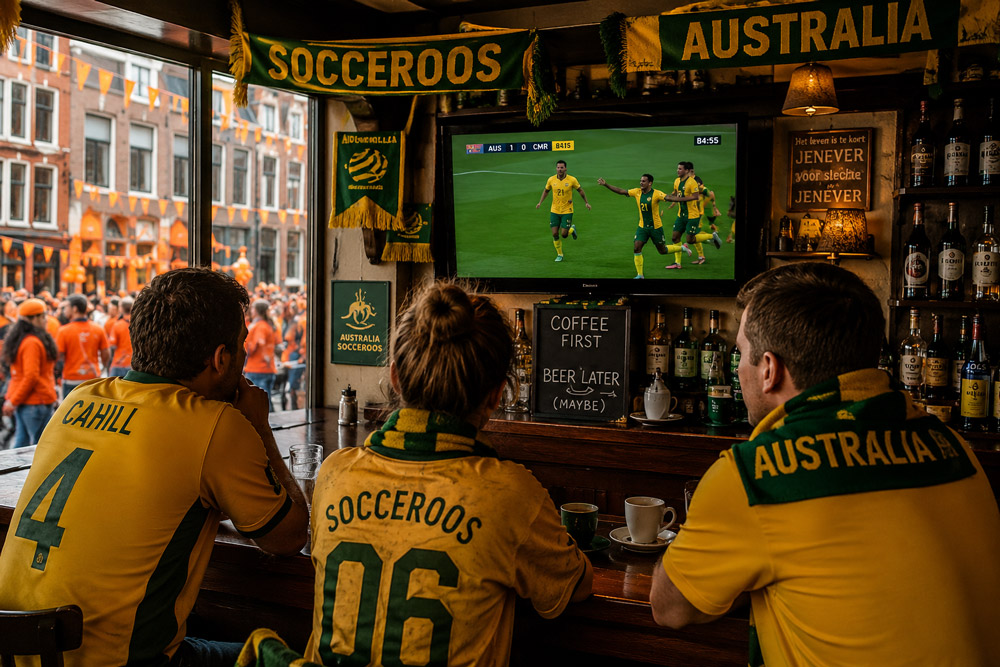
The stadium hums before it roars. But this morning, we are nowhere near a stadium. We are standing in a narrow bar where green-and-gold scarves hang over chairs, where a mounted television flickers above shelves of Jenever bottles, and where three Australian expats are preparing to explain, in great detail, why the Socceroos matter.
Outside, the streets are already streaked with orange. Scarves, jackets and bicycles decorated for King’s Day, that annual Dutch insistence on collective celebration. Inside, the room smells of strong coffee instead of beer. Australia’s match against Cameroon kicks off in the evening back in Sydney, but here in Europe it is still morning. Far too early, everyone agrees, for alcohol.
Josh studies the taps anyway, as though considering a moral exception. “Breakfast beer is still beer,” he says. “No,” Sarah replies, without looking up from her coffee, “It’s a cry for help.” Liam laughs loudly enough that the bartender glances over. By now, he recognises the pattern: morning coffee, raised voices and three Australians suddenly behaving as though the room itself depends on the next ninety minutes.
Sarah grew up around in a small rural village in Western Australia and wears a faded Socceroos shirt from 2006, the fabric softened by time and stubborn loyalty. Liam is from Melbourne and swears loudly enough at missed chances that the staff already know when Australia are playing. Josh, also from Melbourne, insists, before the match has even started, that New South Wales still produces better footballers.
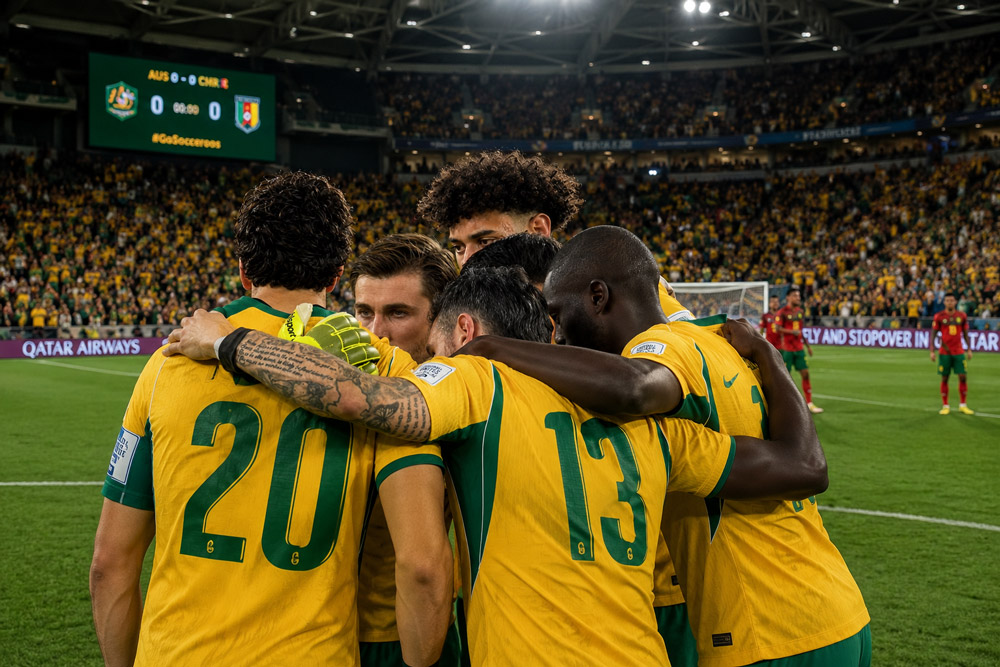
They have all lived in Europe for several years now, but when the Australia men’s national soccer team plays, geography becomes irrelevant. “Back home,” Liam says, lifting his espresso as though it deserves more respect, “football always has to fight for attention.” Sarah smiles. “That’s putting it politely.”
Because in Australia, sport is never singular. There is AFL, rugby league, rugby union, cricket, tennis, Formula One and horse racing treated with near-religious seriousness. Football or soccer, as Australians long insisted on calling it, has often been the outsider. Yet when the Socceroos play, everything narrows.
Attention settles on one field. One ball. One team. As the world turns again towards the spectacle of the FIFA World Cup 2026, we find ourselves tracing a different arc: one shaped less by dominance than by persistence. In Australia, football has never been the only game in town. Yet when the Socceroos play, it becomes, briefly and completely, the most important one.
A nickname that stayed
We begin with a name that still feels slightly improbable. “Socceroos.” A blend of “soccer” and kangaroo. Informal, almost throwaway. Josh grins. “Very Australian, really. Take something serious and give it a name that sounds like a pub joke.” And yet it endured.
Carried across decades of tours, qualifiers, disappointments and reinventions, the name has outlasted the argument over what the sport itself should be called. There is history in that word. It belongs to a time when football fought for recognition, when even its identity felt unsettled. Today, the global game has largely settled on “football”, aligning Australia linguistically with much of the world. But “Socceroos” remains. A linguistic relic that somehow became a badge of affection.
The kit tells its own story. Green and gold – Australia’s national colours – cut brightly against the darker palettes of other teams. On match days, those colours gather people together: in stadiums, city squares, and suburban pubs where screens flicker above crowded tables. They signal something shared, even in a country more accustomed to divided sporting loyalties.
Playing against the current
To understand the Socceroos, we need to understand the terrain they emerged from. Australia is a nation of sport, but not of one sport. Football arrived as an outsider, taking root first in migrant communities.
After the Second World War, Greek, Italian, Croatian and British arrivals brought with them not only a love of the game, but entire footballing cultures. Clubs formed not simply as sporting institutions, but as cultural anchors.
Sarah nods. “My grandfather never said he was going to watch football. He said he was going to the Greek club.” There, football was rarely just ninety minutes. It was language, ritual, and the comfort of recognition. A place where accents did not need explaining.
From those spaces, the game grew. Not loudly, but persistently. Before football belonged to Australia, it belonged to Australians who had arrived from somewhere else.
The night everything changed
Then came November 2005. Stadium Australia. Uruguay. A World Cup place on the line. “Schwarzer,” Josh says. Liam nods. In goal stood Mark Schwarzer. He saved twice in the penalty shootout. When the final penalty was converted, the reaction was immediate and unrestrained.
It was not celebration so much as release. For the first time in 32 years, Australia had qualified for the FIFA World Cup. Liam still remembers where he was. “My dad woke the whole house. I think half the street heard him.” In that moment, Australian football reset. It stopped asking for permission to belong. It simply did.
The golden tournament
At the 2006 World Cup, under Guus Hiddink, belief became visible. Josh remembers Tim Cahill arriving late in the box. Harry Kewell carrying the ball forward. Mark Viduka holding everything together. The Socceroos reached the Round of 16. The campaign ended against the Italy national football team, with a late penalty that still lingers in Australian conversation.
Liam interrupts immediately. “Still not a penalty.” Sarah rolls her eyes. “He says that every single time.” Yet belief held.
Australia qualified again in 2010, 2014 and 2018. Each tournament reinforced presence, even when progress proved difficult. Then, in 2022, the team reached the knockout stage once more. It’s a quieter but equally significant marker of how far it had come.
Beyond the World Cup, there was regional success. In 2007, a semi-final finish at the AFC Asian Cup signalled intent. In 2015, on home soil, Australia won it. The game no longer felt temporary. It felt established.
Harry Souttar and the shape of resilience
When the conversation turns to the modern team, Josh points to the screen before anyone else can. “There, they are talking about Harry Souttar. If you’re talking about presence, start there.”
Harry Souttar is Australia’s tallest ever outfield player, a centre-back whose presence seems to alter the space around him. “Did you know,” Liam adds, “he was helped into the Socceroos setup by the Dutchman René Meulensteen?”
A serious ACL injury threatened his place at the 2022 World Cup, but he returned in time and became one of Australia’s standout players in Qatar. Then, in 2024, a ruptured Achilles tendon forced another long recovery.
Australia opens its FIFA World Cup 2026 campaign against Turkey in Vancouver on 14 June. If Souttar makes that squad, it will be another comeback.
Carrying the game abroad
Australian football no longer exists in isolation. In Europe, players build their craft far from home. At Feyenoord, Jordan Bos learns the tempo of the Eredivisie. At PEC Zwolle, Trent Sainsbury brings experience to a younger side. It is a familiar pathway now. Players leave, adapt and return.
And sometimes, the story loops back in unexpected places. Like here. On the screen, the Australia men’s national soccer team line up against the Cameroon national football team. “It’s different here,” Sarah says, wrapping both hands around her coffee. “Back home, football competes with everything. Here, football is just… understood.” She pauses as Australia press high. “But when Australia plays,” she adds, “it doesn’t matter where you are. You find your people.”
The match is tight. Controlled. More patient than dramatic. Liam mutters at every misplaced pass. Josh predicts three substitutions, all wrong. Sarah smooths the front of that faded 2006 shirt as though it might somehow help. Then, finally, in the 85th minute, the breakthrough. Jordan Bos scores.
The bar erupts with the kind of noise that belongs to midnight, not late morning. Coffee spills. Someone at the next table turns around. Josh forgets his argument entirely and slams his hand against the counter. Sarah leaves her coffee untouched, now cold.
Australia 1 – Cameroon 0. Around us, the cheer arrives late and lingers longer than it should. Distance folds in on itself. The game feels closer than it is.
Where green and gold gathers
To understand the Socceroos fully, we need to experience them in motion: where atmosphere and identity converge.
In Sydney, matches at Stadium Australia offer scale: vast crowds, layered noise and a sense of occasion that builds long before kick-off. In Melbourne, the experience shifts. Football sits alongside other sporting codes and the contrast sharpens its identity. Watching a match in a packed pub at Federation Square can feel as immersive as the stadium itself. Further afield, in cities like London or Amsterdam, the diaspora creates its own pockets of atmosphere.
Games unfold at odd hours, drawing small but committed crowds. Expats, travellers and the curious gather around a shared allegiance. Wherever we are, the pattern repeats: A screen. A crowd and a moment of alignment.
A culture still being written
Football culture in Australia does not rest on centuries of tradition. It is still forming. Still adapting. We see it in the growth of the A-League, in school pitches marked out on sunburnt grass, and in weekend matches where accents and backgrounds blur into something shared. The game belongs to many communities at once.
On international match days, that diversity becomes visible. Supporters gather wherever there is a screen. Songs rise. Sometimes borrowed and sometimes improvised. The rituals are less fixed than in older footballing nations, but no less sincere. Today’s team reflects that globalised game.
Players move between continents, carrying different influences into a shared structure. They are not defined by individual stardom, but by cohesion, discipline and an understanding of their place in the hierarchy of the sport.
With the FIFA World Cup 2026 approaching, anticipation builds again. Each tournament brings the same question: How far can this team go? There is no fixed answer. Perhaps that uncertainty is part of the appeal.
The sound of belonging
The final whistle goes. For a moment, nobody moves. Australia 1 – Cameroon 0.
The result hangs in the room like an unfinished sentence. Then chairs scrape back, coffee cups empty and reality quietly returns. Outside, King’s Day is still in full swing. Sarah pulls on her coat over that old 2006 shirt. Josh resumes an argument about a referee’s decision nobody here can change. Liam leaves coins on the bar and shakes his head at a missed penalty that will be discussed again next match.
At the door, the bartender gives them the kind of nod reserved for regulars. He will see them again for Turkey and probably for every match after that. Then the door opens. Fresh air, bright streets and the sudden swell of celebration. Outside, the city is awash in orange. Music spilling from cafés, bicycles draped in flags and strangers laughing with the easy confidence of a national holiday. We step straight into the cheerful chaos of King’s Day, carried along by the crowd. And suddenly, they are no longer just three expats in a bar. Between all that orange, there is green and gold.
Sarah’s faded shirt. Josh still arguing. Liam laughing as someone mistakes the Australian scarf for Brazilian football colours. They move through the streets, still carrying Australia with them. Whether in Sydney, Melbourne, or in the middle of a Dutch national celebration on the other side of the world, the feeling is the same. Green and gold, movement and noise, the brief certainty of belonging. That is what the Socceroos have become. Not just a team, but a place people return to.
And somewhere between the orange of King’s Day and the green and gold of Australia, that feels like the truest victory of all.