
The story of the All Blacks and the sport that shapes a nation
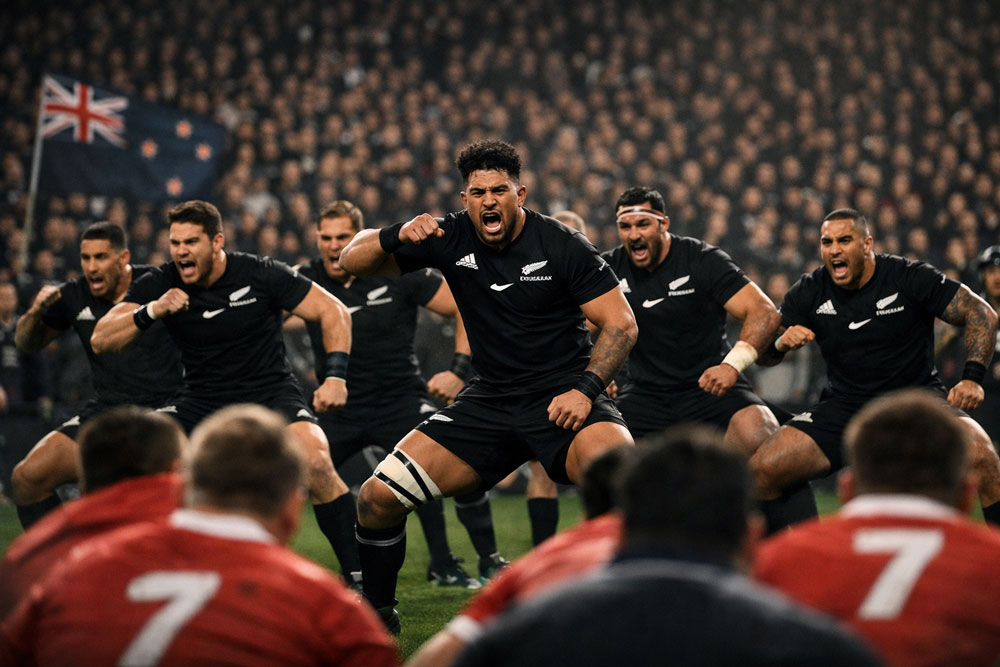
The stadium falls silent. Tens of thousands of supporters in black jerseys wait as New Zealand’s players line up across the field. Then the rhythm begins. Feet stamp, hands strike chests and thighs, voices rise and fill the air. The haka rolls forward like a wave. For opponents, it is a warning; for supporters, a familiar beginning. While much of the world turns its attention to the FIFA World Cup, New Zealand has long had its own sporting centre of gravity. Here, a national pride does not resolve around a round ball, but an oval one and the team that has defined the country for more than a century: the All Blacks.
A nation in black
In New Zealand, the black rugby jersey is everywhere. In sports shops, airports and cafés. It appears as a quiet marker of identity. The kit is simple. Black from head to toe, with a silver fern on the chest. Yet it has become one of the most recognizable symbols in global sport. The All Blacks are widely regarded as one of the most successful teams in sporting history. For more than 130 years, they have won the majority of their matches. Over three quarters, a statistic that underlines their dominance. For many supporters, victory is not a surprise but an expectation. The expectation runs through everything. Players do not simply wear a jersey; they inherit a legacy.
The origins of a mindset
To understand that legacy, it helps to look back to the early twentieth century. In 1905, a New Zealand team, later known as the Originals, travelled to Great Britain. Led by Dave Gallaher, they won 34 of their 35 matches. That tour laid the foundation for a culture in which winning became the standard. Not an ambition, but a baseline. Subsequent generations built on it. Leaders such as Richie McCaw came to embody that tradition: discipline, awareness and an unrelenting work ethic. History is not a burden here, but a direction.
Rugby as social glue
Rugby in New Zealand has long been more than a sport. In its early years, it brought people together: settlers, workers and farmers. Its physical nature mirrored the realities of daily life. While rugby remained an elite sport in some countries, in New Zealand it became a game for everyone. Fields appeared in towns and cities and clubs became social hubs. That role has endured. During matches, the country seems to pause. In cafés, living rooms and public spaces, people follow every phase of play. Not just for the result, but for the shared experience.
The foundations of success lie in schools. Rugby is not an extracurricular activity but a natural part of everyday life. In almost every tow, teams are active. Matches draw crowds, regional tournaments create rivalries and connection. For young players, these fields are the first step on a long path.
Coaches, former players and scouts guide emerging talent. Just as important, however, is the environment: parents on the sidelines, classmates in the stands and communities that invest emotionally in the outcome. It is here that not only players are shaped, but a mindset.
The path to the top
From school teams, players progress through clubs and provincial sides into professional rugby. Only a select few reach the national team. That makes the black jersey all the more significant. Those who wear it represent not just themselves, but a system that has developed talent for generations. The strength of the All Blacks lies not only in individual brilliance, but in a structure that identifies, nurtures and sustains excellence.
The haka: a moment of focus
Just before kick-off, the atmosphere shifts. The players gather, form a line and begin the haka. The movements are sharp, the voices forceful. The ritual is globally recognized, yet difficult to fully explain. It is preparation, focus and confrontation in one. One of the most well-known versions, Ka Mata, was composed in the early nineteenth century and tells a story of danger and survival. Today, those same words are performed in a different setting: a stadium, a match and a global audience.
In 2026, footage of the haka is no longer easily accessible. Its commercial value has become too significant. Those who wish to watch must rely on official platforms or brief highlights. It speaks to the ritual’s global appeal: even without understanding rugby, people recognize its intensity.
Dominance and vulnerability
The contrast remains striking: a country of just over five million people that has dominated world rugby for more than a century. The numbers are compelling. The all blacks have won over 75 percent of their matches, reached their 500th Test victory ahead of any other team and appeared in more Rugby World Cup finals than any rival since the tournament began in 1987.
Yet dominance is never absolute. In 2025, a heavy defeat to South Africa served as a reminder that even the strongest teams are not immune to setbacks. Moments like these reinforce the standard. Loss is not dismissed, but examined. Part of the same culture that makes sustained success possible.
More than statics
Former player Ian Jones has noted that the story of the All Blacks is not defined by trophies or records alone. It is about the environment in which players operate. Behind every victory lies a structure. Training, discipline and mutual respect form its core. Success is not treated as chance, but as the outcome of a system designed to produce excellence. That system is both visible and intangible. It can be seen in performance, but also felt in the way players carry themselves on and off the field.
Looking ahead
With the rugby World Cup in Australia in 2027 approaching, attention once again turns to the global stage. New opponents and new generations bring fresh narratives. Recent results suggest momentum is returning. Wins are accumulating, confidence is rebuilding. But expectations remain unchanged. For the All Blacks, every tournament is an opportunity to reaffirm a tradition that spans generations.
More than a team
The All Blacks have become a symbol that extends far beyond sport. The black jersey and silver fern represent a form of national identity recognized worldwide. Yet the essence lies not in the symbols themselves, but in what happens when the game begins. When the players line up and the haka starts, everything converges: history, preparation and expectation. For a brief moment, there is only the field, the rhythm and the silence before it. Somewhere within that moment lies the reason rugby in New Zealand is more than a sport.