A memory sparked
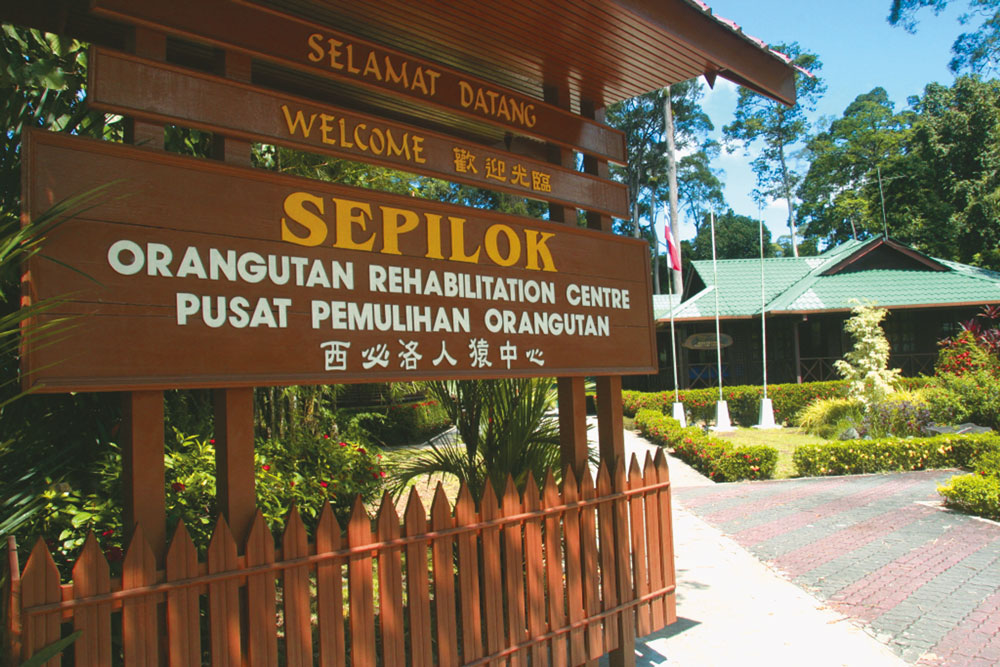
We are watching the Netflix documentary The Secret Life of Orangutans when a scene lingers. A mother moves fluidly through the Bornean rainforest, her infant clinging, slipping, learning as it tries to follow. It is a portrait of patience and instinct, intimate, almost disarming, and it draws us back to our own journey to Sepilok in Sabah.
We have come here because it is said to be one of the most meaningful places on Earth to encounter orangutans in a semi-wild setting. Expectations run high. We set off early, the road unfolding in quiet transitions: busy roadside villages give way to open green stretches, before the dense fringe of rainforest begins to close in. Along the way, our driver speaks candidly about the pressures facing Borneo’s forests – logging, agricultural expansion, fragmentation – but also about the efforts to protect what remains. Sepilok, he tells us, sits within that fragile balance.
The reality is layered. While the rehabilitation centre prepares orangutans for a return to the wild, the threats persist. Habitat loss continues, and survival is far from guaranteed. Yet recovery, however gradual, is possible. Since its founding in 1964, on the edge of the Kabili-Sepilok Forest Reserve, the centre has cared for hundreds of orangutans, many of which have successfully returned to the forest. It is not a complete solution, but it is an essential one.
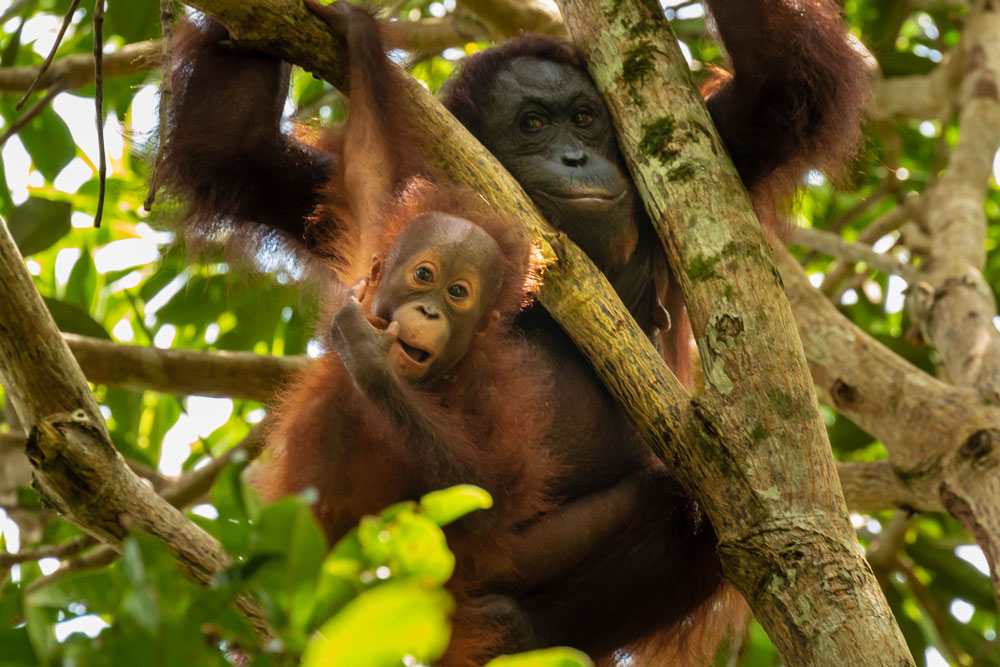
Entering the forest
Arrival feels like stepping across an unseen threshold. The rainforest closes around us immediate immersive. Humidity settles on the skin; the scent of damp earth rises with each step. Sound carries differently here: layered, constant and alive.
We are guided into a small auditorium, where a short film introduces the work of the centre. Orphaned orangutans, displaced by deforestation or the illegal wildlife trade, are given a second chance. One moment lingers: an orangutan reacting with unmistakable delight as rain begins to fall. The room softens with quiet laughter. It is a small detail, yet it dissolves distance. A reminder of how closely our worlds still intersect.
Beyond the screen, the forest stretches across 43 square kilometres of protected land. Around 80 orangutans move through this space in relative freedom.
They are not confined, nor are they required to appear. Human interaction is deliberately minimal. What we see (or do not see) remains entirely on their terms.
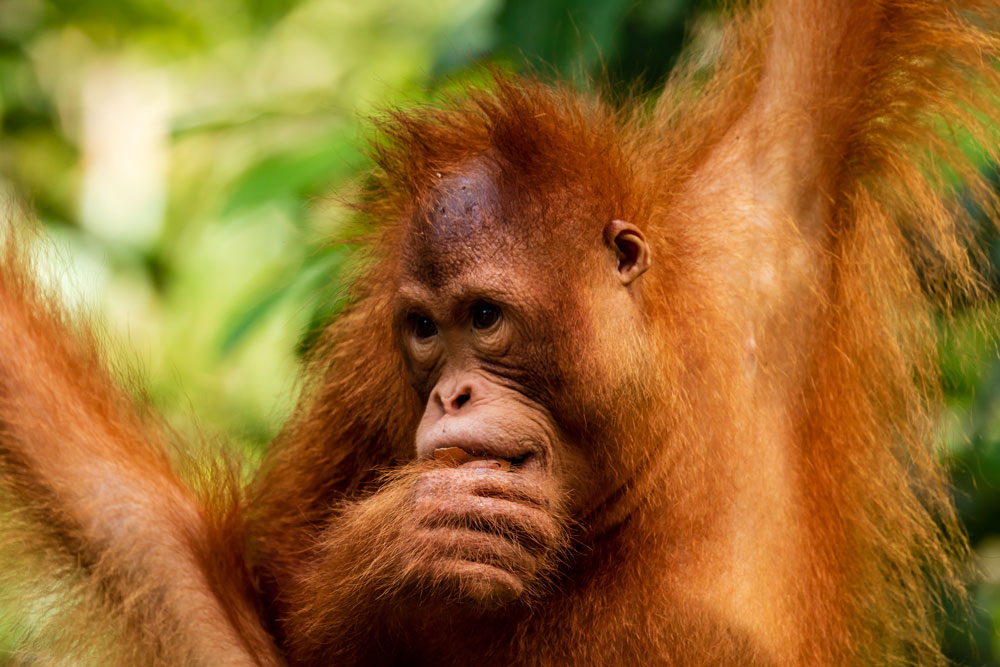
Life in the canopy
We follow a narrow path into the forest, the canopy above forming a shifting green vault. Light filters through in fragments, illuminating a world that feels both ancient and immediate. Life is everywhere: vast spider webs suspended between branches, insects that seem almost prehistoric, millipedes threading through leaf litter, butterflies flickering in sudden bursts of colour.
Then… movement overhead. Our first orangutan appears high in the canopy, moving with quiet precision. Each motion is deliberate, unhurried. Its reddish coat catches the light, glowing briefly before dissolving again into shadow. It pauses, almost suspended, and for a moment it seems to observe us. Then it continues, swinging deeper into the forest with effortless control.
There is no spectacle here, no performance. Only presence. And it is enough.
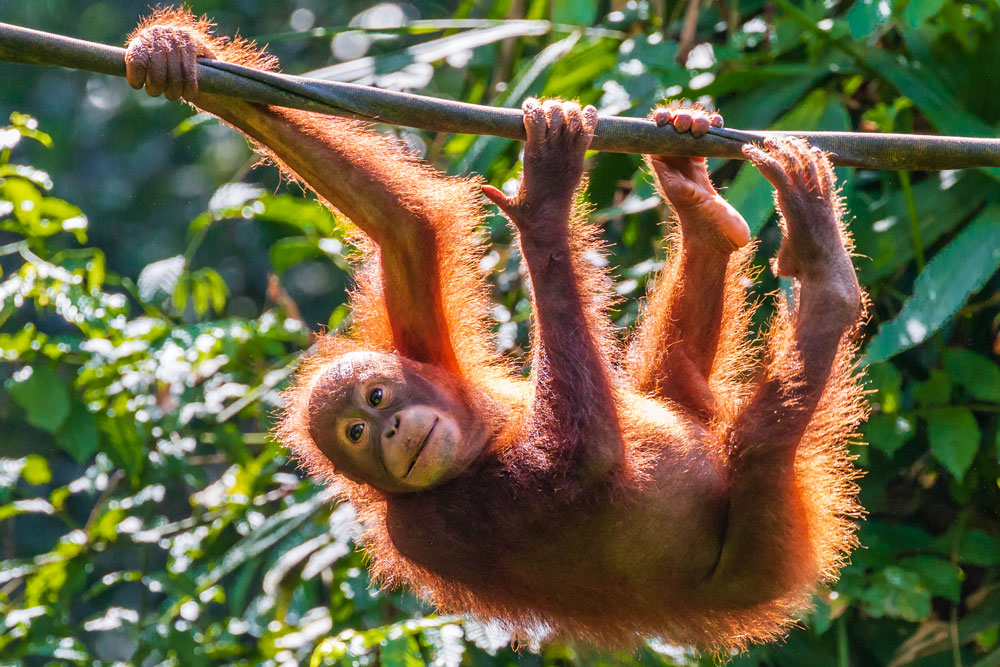
Learning to be wild
At the nursery, the mood shifts. Visitors remain at a distance, observing through glass as the youngest orangutans practise the fundamentals of survival. Ropes and platforms mimic the architecture of the forest, forming a training ground for life beyond human care.
One infant crosses a rope bridge with tentative confidence; another struggles with a branch just out of reach. Two tumble together in play, while a fifth lies on its back, gazing upwards, absorbed in its own quiet world. The scene is disarmingly familiar: playful, awkward and full of small victories.
Yet the context is unavoidable. Each animal here has lost something essential: a mother, a habitat, a beginning that cannot be restored.
Caregivers work with quiet patience, encouraging instinct rather than dependency. Each orangutan develops differently. Some are curious, eager to explore; others remain cautious, observing before acting. Rehabilitation follows these rhythms, allowing space for individuality. A reminder that survival, even here, is never uniform.
The weight of intelligence
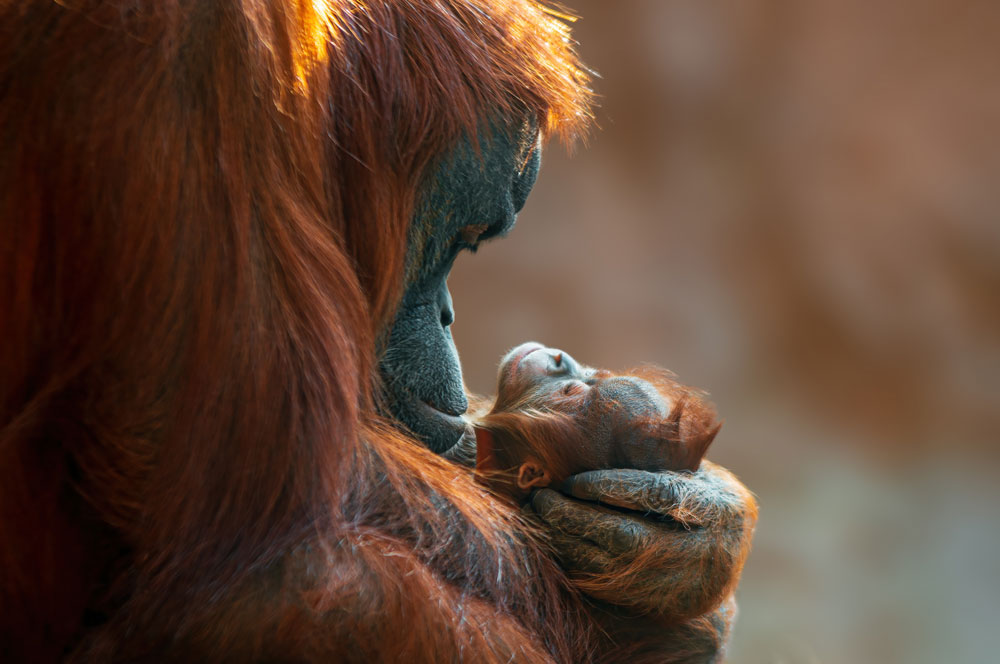
Orangutans are often described as solitary, but this simplicity conceals a deeper complexity. Their lives are shaped by intelligence, memory and emotional awareness. The bond between mother and infant is profound, lasting several years, during which essential skills are passed on, how to move, what to eat and where to rest. When that bond is broken, the consequences are lasting.
Their diet is varied; fruit, bark, leaves and insects, and as they move through the forest, they disperse seeds, sustaining the ecosystem itself. In this sense, they are not merely inhabitants of the rainforest, but architects of it. Without them, entire systems begin to shift.
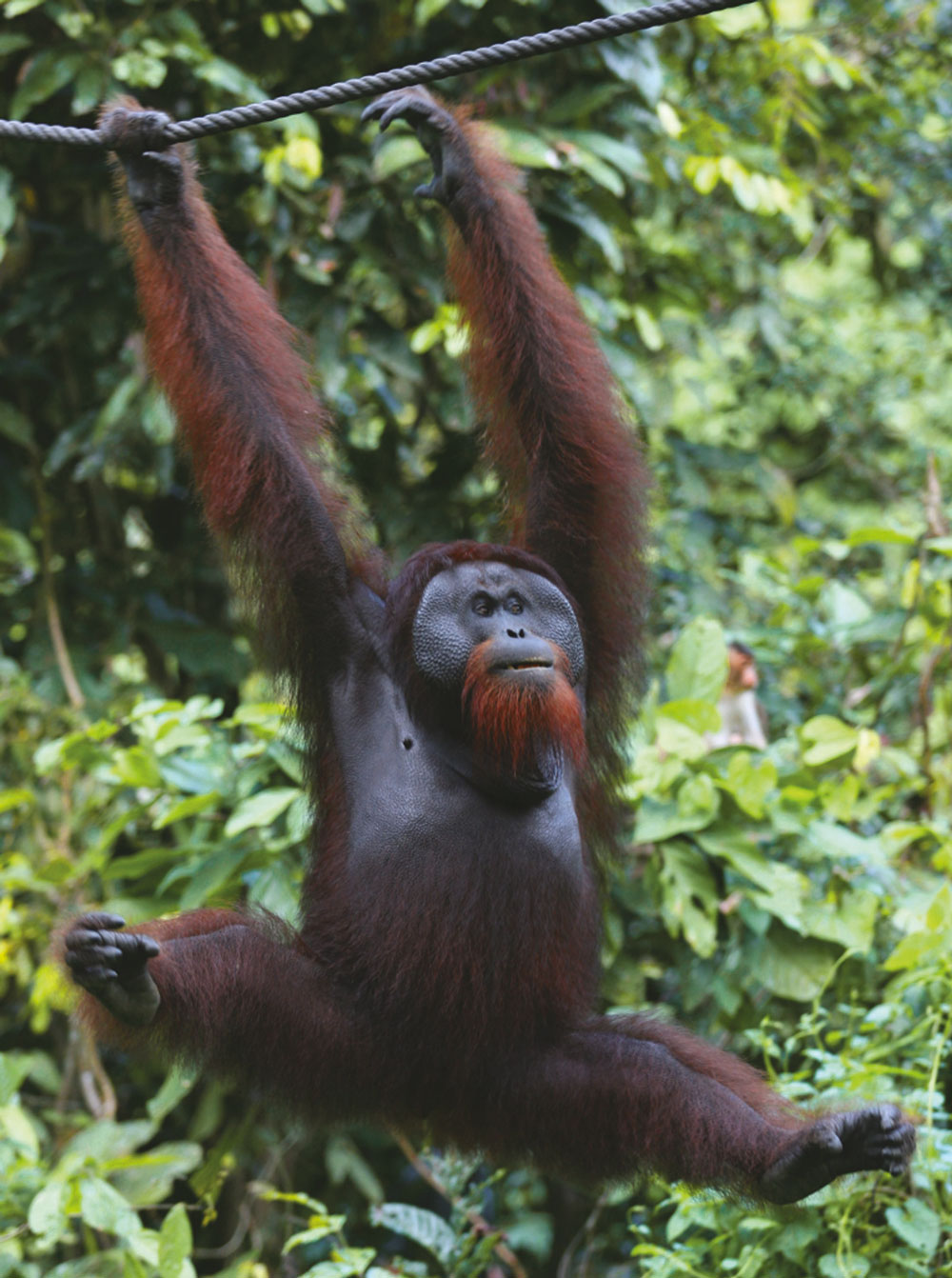
Adult males, with their distinctive cheek pads, embody a different presence; slower, more deliberate, carrying the weight of dominance and territory. Yet even here, there is nuance. Orangutans fashion tools from branches and leaves, using them to access food or shield themselves from rain. They have been observed sharing resources, even tending to injured individuals. Intelligence here is not abstract; it is lived, adaptive and essential.
And yet, for all this resilience, their survival remains precarious. The forest they depend on continues to shrink. Conservation, in this context, is not an ideal. It is a necessity.
Waiting for presence
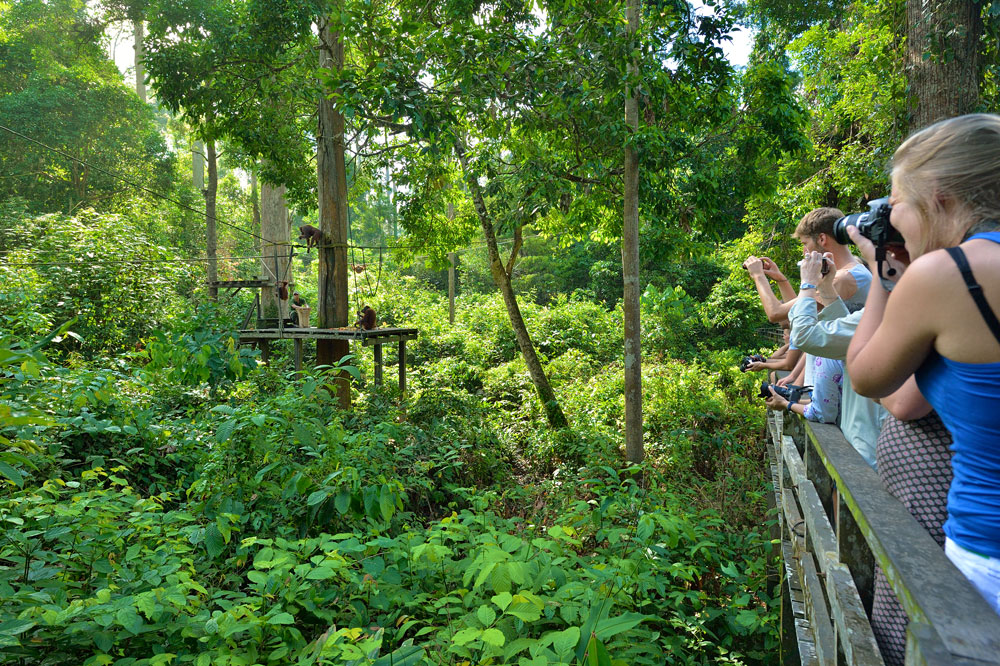
At the feeding platform, we wait.
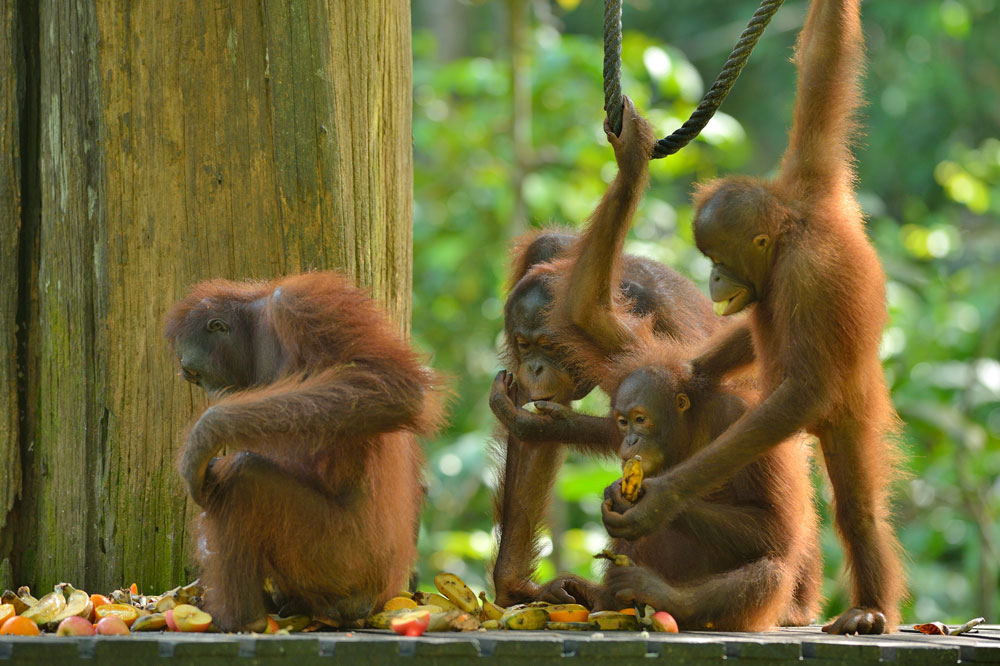
Twice a day, fruit is placed here, not as spectacle, but as support. Our guide reminds us that absence is not failure. If no orangutans appear, it means they are feeding successfully in the forest. Independence, not visibility, is the goal.
Still, anticipation builds. The platform sits at a distance, framed by trees and shadow. Then, a subtle shift. Ropes tremble slightly. A young orangutan arrives first, direct and unhesitating, claiming its place among the fruit. A female follows, her infant clinging to her back. She feeds calmly, occasionally allowing the youngster to explore, to test its own boundaries. The moment unfolds quietly and without urgency. There is no need for more.
A shared gaze
Then, almost imperceptibly, the atmosphere changes.
A larger figure moves through the canopy, slower and heavier. The dominant male emerges, descending with measured control. His presence is immediate, defined not by movement but by stillness. He settles, surveys, exists within the space as though it belongs entirely to him.
We watch, transfixed. His gaze is steady, attentive. There is something unmistakably familiar in it, Not resemblance, exactly, but recognition. For a fleeting moment, the distance between species feels less certain.
We raise our camera, instinctively, trying to hold on to the scene. But the conditions resist us. Light fractures through the canopy, shadows obscure detail. Later, reviewing the images, we find little of what we hoped to capture. The orangutans appear as silhouettes, fragments of movement against green.
It does not matter. What remains is sensory: the thickness of the air, the sound of branches shifting under weight, the brief, unspoken connection of eye contact. These are not things a photograph can hold.
Carrying it forward
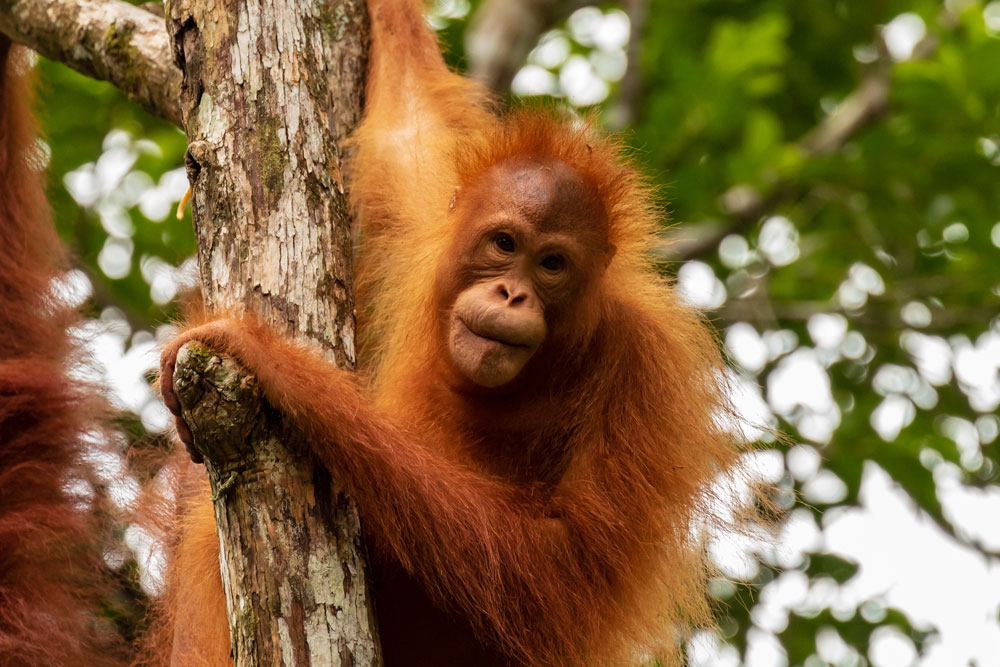
As we leave, the forest does not end abruptly. It recedes slowly, giving way to roads, to distance, to the familiar rhythm of movement. Conversation turns reflective. What stays with us is not only the encounter itself, but the context surrounding it: fragility, effort, the quiet persistence of those working to restore balance.
Sepilok offers no illusion of untouched wilderness. Instead, it presents something more complex. A place where intervention and independence coexist, where recovery is possible but never complete. It is this honesty that lingers.
Back in daily life, such experiences risk fading into routine. Yet something resists that erasure. A shift, perhaps subtle, but enduring. To witness these animals is to recognise not only their vulnerability, but our place within that equation.
We think again of the young orangutan from the film, moving through the forest, learning its rhythms. What defines her days now? What does survival look like, moment to moment, in a world that is both ancient and increasingly uncertain?
We do not have the answer. But the question remains. And with it, a quiet resolve. To stay attentive to what places like Sepilok reveal: that the wild is not separate from us, but deeply, inextrably connected.