The Archipelago that lives in my mind
The spark of a dream
Some journeys don’t begin with a plane ticket or a boat ride. They begin with imagination. For me, the Marquesas Islands are exactly that kind of place.
I’ve never set foot there, and yet they have lived in my thoughts for decades. Fed by books, documentaries and the stories of those who traveled before me. Even now, as I write, I can almost feel the pull of that distant place. There’s no departure gate, no passport control. Just the quiet stir of longing. It’s as though the islands are calling me: come, discover us. And I listen.
A weeknight that changed everything
It all starts on a weeknight when I am twelve. Sitting with my father, I
watch De Wereld van Boudewijn Büch, a Dutch travel program. At that point, I’ve never been outside Europe. Yet, as Büch speaks, the living room transforms into a departure hall to faraway places.
Büch’s poetic narrative conjures up visions of turquoise lagoons, women in flower crowns and cliffs towering over turbulent seas. He paints not just with words, but with the spirit of adventure. His stories awaken something deep inside me.
Years later, I find myself watching Globe Trekker on VHS. Ian Wright’s carefree exploration of Fiji, Vanuatu and the Solomon Islands, pulls me in to. Though it’s the absence of one place that lingers my mind: The Marquesas Islands.
Te Henua Enana, the Land of the people.
While others dream of Bora Bora, I find my finger tracing that almost imperceptible dot on the map, the Marquesas.
Islands born of fire
But that tiny dot hides a powerful story. Beneath the surface of the Pacific Ocean, fire once bubbled up from deep within the Earth. The Marquesas, like Hawaii, are the results of a volcanic hotspot. A chamber of molten rock that slowly pushed islands out of the sea as the Pacific plate drifted over millions of years.
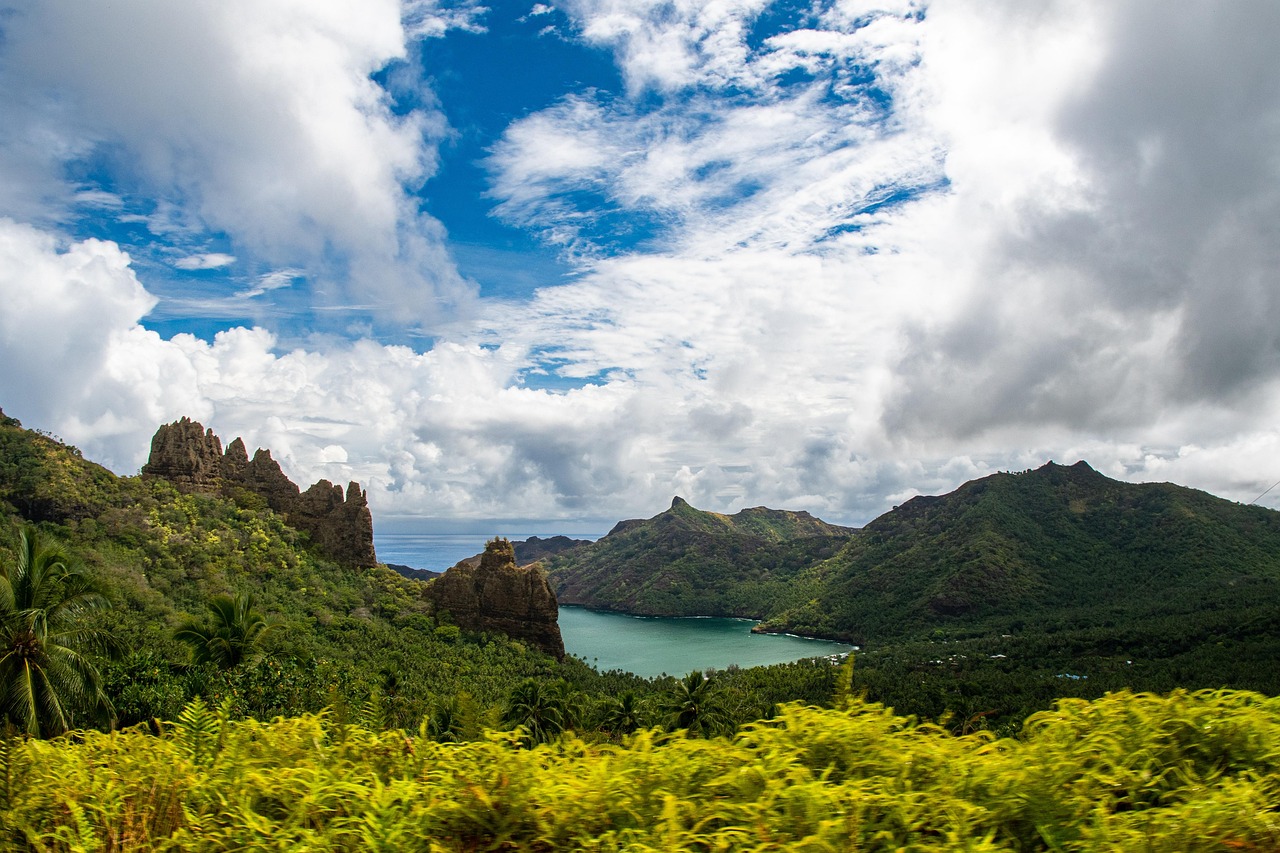
Today, the Marquesas rise like dark sentinels from the ocean, their jagged peaks and dramatic cliffs starkly different from the turquoise lagoons of other Polynesian islands. It’s an archipelago of contrasts: Rugged beauty, steep mountains, misty valleys and waterfalls that cascade hundreds of meters down.
It is at once formidable and alluring, repelling and drawing you in.
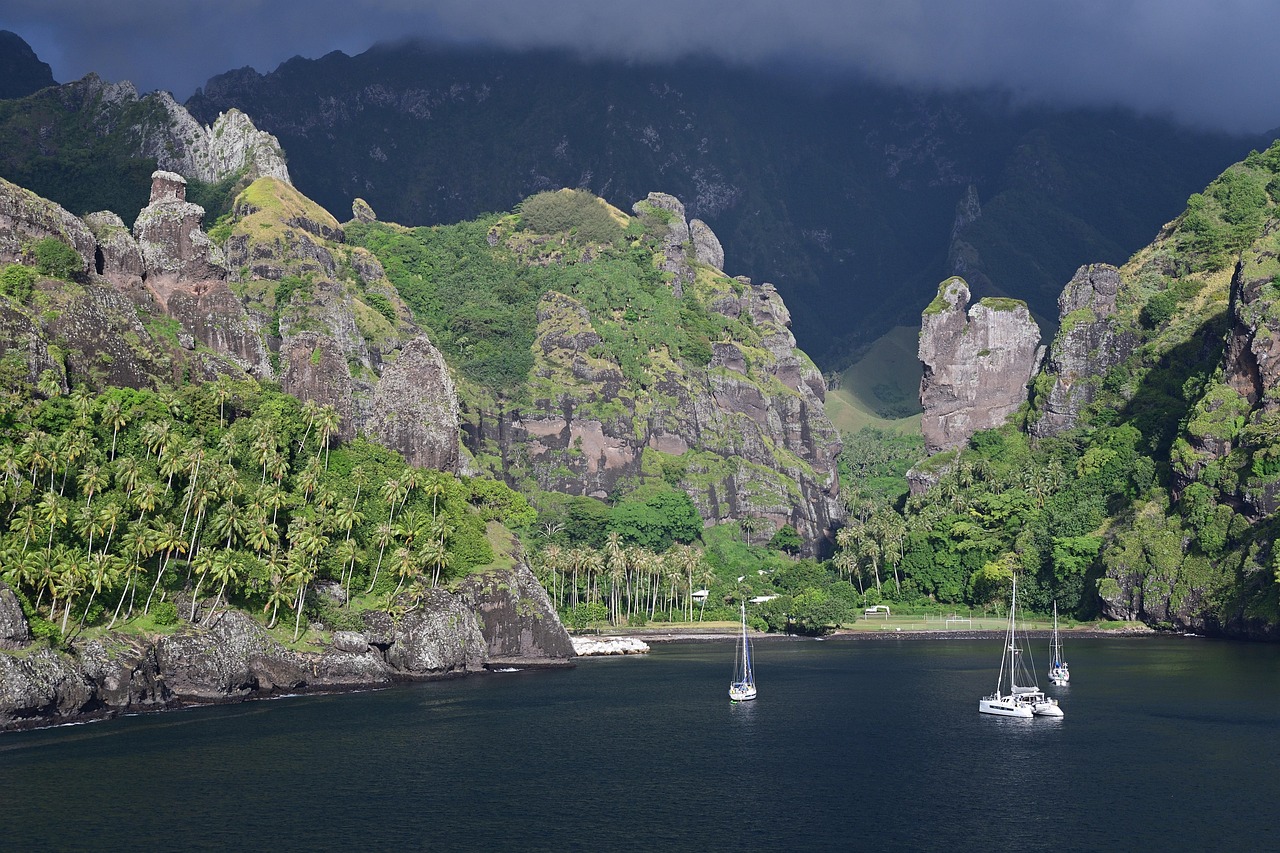
The islands’ cultural and natural significance has earned them UNESCO World Heritage status. Still, the Marquesas remain isolated, a place where time feels as if it moves more slowly than the rest of the world.
More than 4.800 kilometers from the nearest continent, fewer than 10.000 people live on the Marquesas. They are scattered across small villages that are far removed from the modern world, connected more by the sea than by roads. The legendary Aranui cargo ship brings supplies to the islands and carries travelers willing to take the long, slow journey into the heart of the Pacific.
A different kind of Polynesia
This is what makes the Marquesas so exceptional: They are a world apart from the more famous islands of Polynesia. Where Bora Bora and Moorea lure travelers with resorts and crystal-clear lagoons, the Marquesas offer no overwater bungalows or Instagrammable sunsets. Instead, they offer simplicity, peace, tradition and time in its purest form.
In a world where travel has become faster, more efficient and more commercialized, the Marquesas stand as a peaceful counterpoint. Here, life still moves according to the rhythm of nature. People know when the tide is high, not because of an app, but because they live with the ocean. Children run barefoot through fields, not through pixels.

The library as a departure gate
As a teenager, the islands find a new home in my imagination. This time through books. The library becomes my departure hall. It’s there I discover the stories of artists, explorers and writers who made the Marquesas their own.
Paul Gauguin, seeking an artistic refuge, arrived on Hiva Oa and painted some of his most famous works there. He died on the island in 1903, and his grave still overlooks the bay of Atuona, surrounded by frangipani trees.
Belgian singer Jacques Brel, too, found his last refuge in the Marquesas. He sailed into Hiva Oa, stayed and died there, leaving behind music that still echoes through the islands.
Herman Melville, after deserting his whaling ship, lived for months on Nuku Hiva in 1842. His time there inspired Typee, a novel that romanticized the Marquesas as the ultimate escape.
Other writers, like Robert Louis Stevenson and Jack London, also visited the islands, each discovering something unique about the tension between paradise and hardship. Their stories have one thing in common: Escape.

So close, yet out of reach
As a nineteen-year-old backpacker, I set out on my first world journey. My route takes me from Christchurch to Los Angeles, with Tahiti appearing on the map as a sparkling, almost reachable dot. But my budget fails me. I don’t make it to Polynesia. The tiare flower garland stays unwrapped. Instead, I pass the Marquesas like a dream slipping away. It’s a missed opportunity that only deepens my longing.
Timeless
The years pass, filled with the usual demands of study, work and family, but the Marquesas never leave my mind. Sometimes, I find myself on Google Earth, zooming in on that expanse of blue until those dark green dots slowly rise before me. In the midst of my daily life, I read an article about Nuku Hiva and Hiva Oa and the fire rekindles. The Marquesas are still there, waiting for me. Just as they’ve always been. It’s as of the islands are speaking again: You were close and the journey is still waiting.

A journey of the mind
And so I continue to visit the Marquesas, not physically but in my imagination.
I imagine sailing into the bay of Taiohae, the largest island in the archipelago.
I see the imposing Mount Tekao towering over the landscape.
I move on to Hiva Oa, often called the “Garden of the Marquesas,” where the graves of Gauguin and Brel look out over the Pacific, their final resting places surrounded by frangipani flowers.
I journey further south to Ua Pou, with its dramatic spires rising from the ocean like cathedral towers, and then to Ua Huka, a quiet dry island where wild horses roam the hills.
The small island of Tahuata, “the house of the dawn,” offers hidden coves and beaches where local artisans craft oils from tiare flowers.
Finally, I reach Fatu Hiva, the most isolated and mythical of all the islands, with its steep mountains and dense valleys, where traditional tapa cloths are still made by hand.


Perhaps one day
Some journeys begin long before any passport is stamped. They live in the mind, fueled by stories, images and dreams.
Since I was twelve, the Marquesas have lived in my thoughts. Quiet companions on a journey I’ve never taken. Perhaps one day I’ll finally sail there with my family. Or maybe not. But even if I never set foot on those islands, the journey will remain. A compass of longing that started with a television program and has never faded.
By Robin