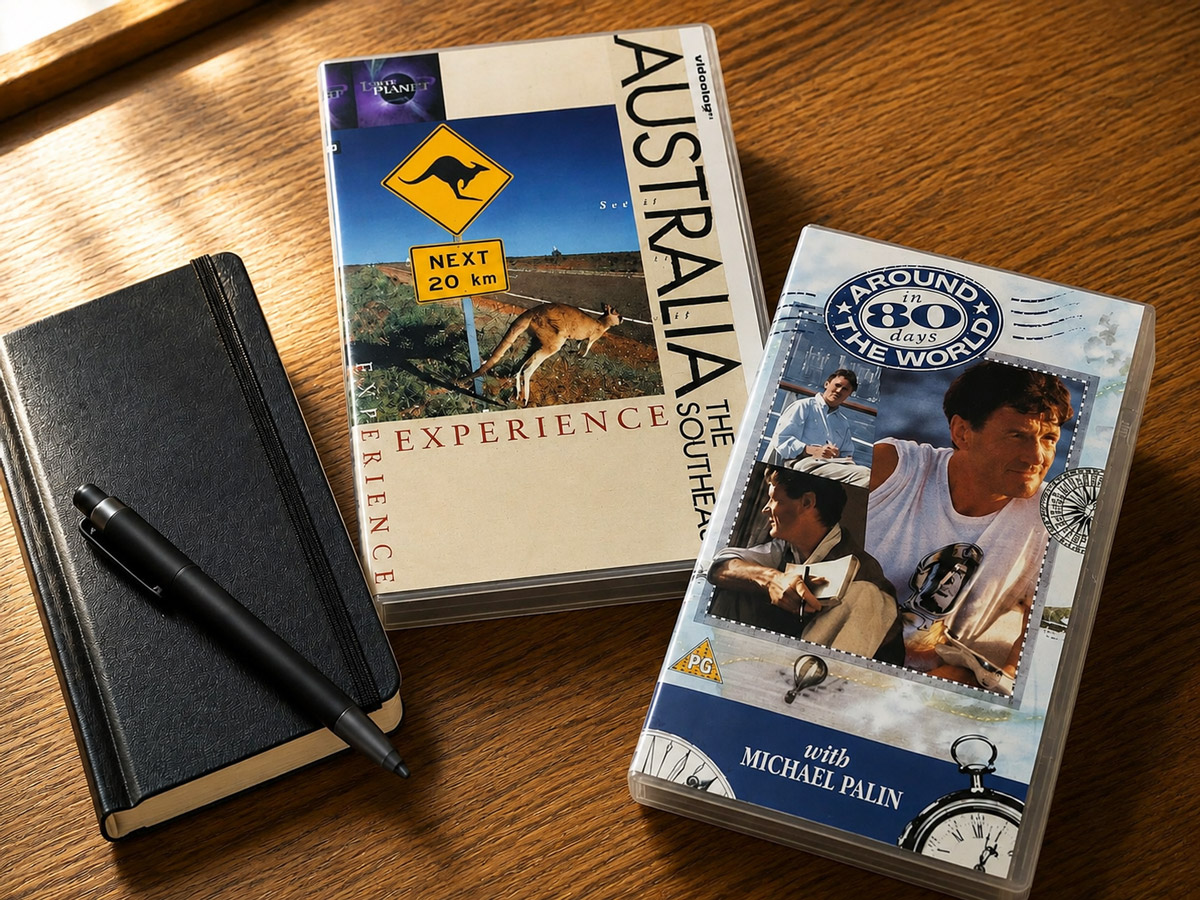
There are people who teach you to travel without ever knowing they have become your companions. They appear on a television screen somewhere between dinner and bedtime, and suddenly you are thousands of miles from home. For me, they were Sir Michael Palin and Ian Wright.
Palin arrived quietly. Curious, slightly bewildered, occasionally uncomfortable, but always willing to see what happened next. Wright arrived with rather more momentum, as if someone had just told him there was something extraordinary happening around the corner and he had better get there immediately.
Two very different travellers. And that was precisely the point.
Michael Palin travelled with the curiosity of someone who understood that a place could never be completely explained. In Around the World in 80 Days, the journey itself was often the story. A dhow crossing the Arabian Sea became an encounter with time, weather and uncertainty rather than simply a way of getting from one port to another. When the engine failed and the vessel drifted dangerously close to minefields, Palin remained remarkably composed. Not because he was fearless, but because curiosity seemed to have a habit of getting there before fear. That was his gift.
He never needed to be the loudest person in the room to hold your attention. A train journey through India could be enough. Amid the noise, smells and constant movement, he allowed himself to be absorbed into everyday life. When plans unravelled; a delayed connection, an awkward encounter, a journey that refused to go according to schedule, he rarely seemed irritated. Instead, he appeared interested in the detour itself. As though a failed plan was simply another route into the story.
Ian Wright had a different approach. If Palin opened an unexpected door cautiously, Wright was usually already through it. His travelling was physical, exuberant and wonderfully unpolished. He did not merely want to observe a place; he wanted to take part in it. And that could mean anything from dancing with locals in the Pacific to eating something that most sensible people might first want to inspect very carefully.
In Australia, that something was a witchetty grub. The camera catches the hesitation. Wright looks at it. He looks at the person offering it. There is a brief calculation – perhaps involving the possibility of escape – and then he eats it. It is a small moment, but it captures something essential about him. He never pretended that everything was delicious, comfortable or easy. His face told you exactly what he thought. Disgust, curiosity, amusement and a degree of disbelief could all arrive at once. And yet he tried. That was Wright’s gift. He made curiosity feel physical. You could almost feel yourself leaning towards the screen, wondering whether you would have done the same. Probably not. But perhaps that was the point.
Palin made you want to listen to the stranger beside you on the train. Wright made you want to say yes when that stranger suggested something completely unexpected. One slowed the world down. The other threw himself into it. Yet beneath the difference in temperament was the same instinct: people came before places.
Neither man travelled as though destinations were trophies to be collected. They were interested in what happened between the famous landmarks; the conversation, the meal, the awkward silence, the unexpected invitation. A place became memorable not because it appeared on a map, but because someone there opened a door, poured a drink, told a story or dared them to try something they had never tried before. That feels worth remembering now. We live in a world where borders and differences can seem to matter more than ever, where the news can make the distance between people feel enormous. There is something about Palin’s instinct to listen and Wright’s instinct to engage. Not everything needs to become a grand lesson in international relations. Sometimes it is enough to sit down with someone, share a meal and discover that the person on the other side of the table is, inconveniently, rather human. We could use a little more of that.
That is perhaps why their programmes stayed with me long after the television had been switched off. They made travel feel less like an achievement and more like an attitude. There were no perfect days. There were delays, discomfort, missed connections and moments when a sensible person might reasonably have wondered why they had agreed to any of this in the first place. Palin could find himself dressed for a formal reception in Hong Kong in the middle of a journey that had otherwise involved ships, trains and considerable uncertainty. Wright could find himself on a horse in Mongolia or facing an unfamiliar dish, looking as though adventure had suddenly acquired rather more consequences than advertised. Neither seemed embarrassed by being imperfect travellers.
That mattered. Because it made the world feel accessible. You did not need to be fearless.
You did not need to know everything. You simply needed to be willing to look, to listen and, occasionally, to make a fool of yourself. Perhaps that is where their influence still lingers.
When I travel now, I am drawn to the same things they were drawn to: the road that takes longer than expected, the café that was not in the plan, the stranger who starts talking, the meal whose ingredients are not entirely clear. The landscape matters, of course. So do the great journeys and the places we dream of seeing. But the stories usually begin somewhere smaller. At a table. On a platform. At the side of a road. Or, in Wright’s case, with something that has far too many legs. Palin and Wright did not make the world smaller by explaining it to us. They made it bigger. They showed how much remained unknown, how many lives were being lived beyond our own horizons, and how much could happen when you allowed a journey to become something more than getting from A to B. They were my first travel companions.
Perhaps, without knowing it, they were also my first teachers in the craft of travel writing. Palin taught me to look twice. Wright taught me to step forward. Between them, they left a simple lesson: the best stories are rarely waiting exactly where you expect to find them. You have to leave the door open. And sometimes, you have to eat the grub.