In outback Queensland, the origins of a global airline remain grounded in dust, distance and quiet ingenuity at the Qantas Founders Museum in Longreach
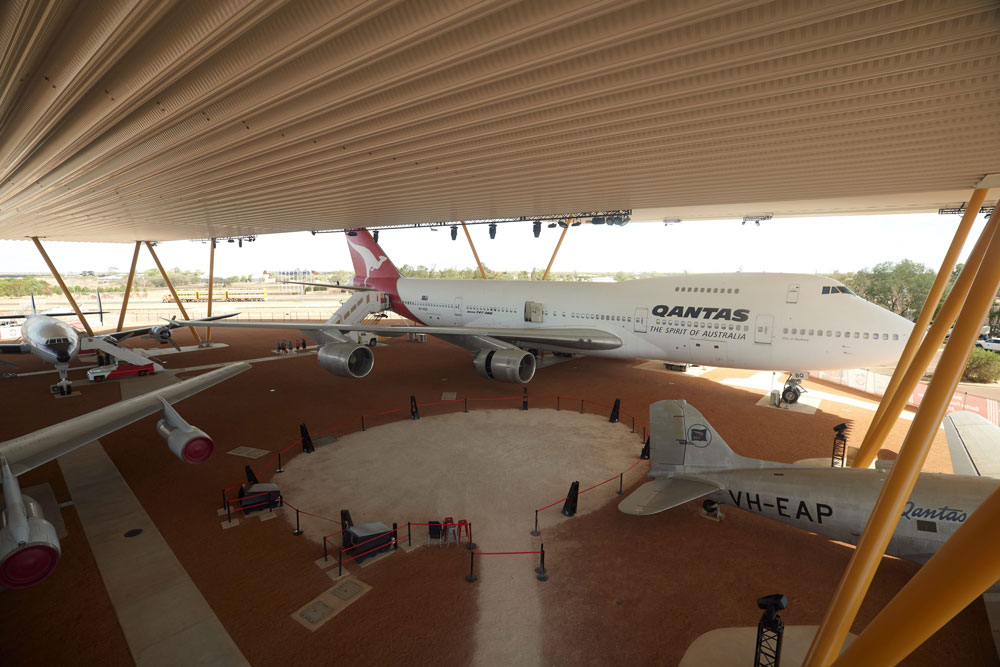
The hangar appears almost by accident. One moment we are driving through Longreach, past low buildings bleached by the sun, streets tapering into heat haze. The next, a vast corrugated structure rises from the plain, its edges softened by wind and time. Inside, the air cools, carrying a faint trace of oil and old timber as sound settles. With it comes the quiet recognition that this is not simply a museum, but a beginning.
We pause just beyond the threshold. Timber beams stretch overhead like ribs; somewhere high in the structure, metal ticks softly as it contracts in the heat. The space feels functional, but not without reverence. Nothing here suggests spectacle. Instead, it speaks of process. Of things assembled slowly, tested and, eventually, made to work.
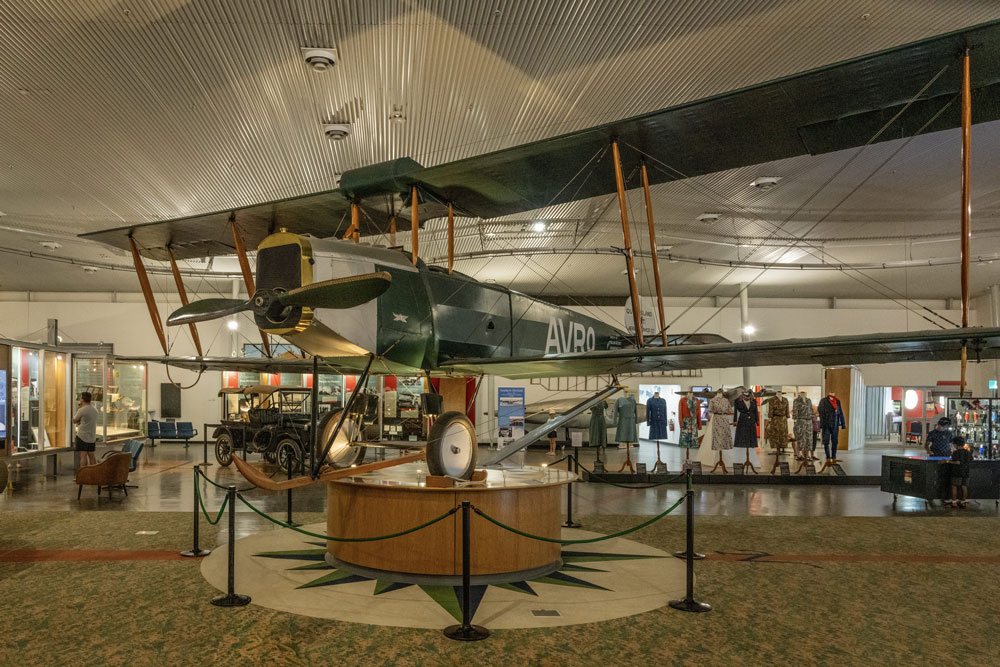
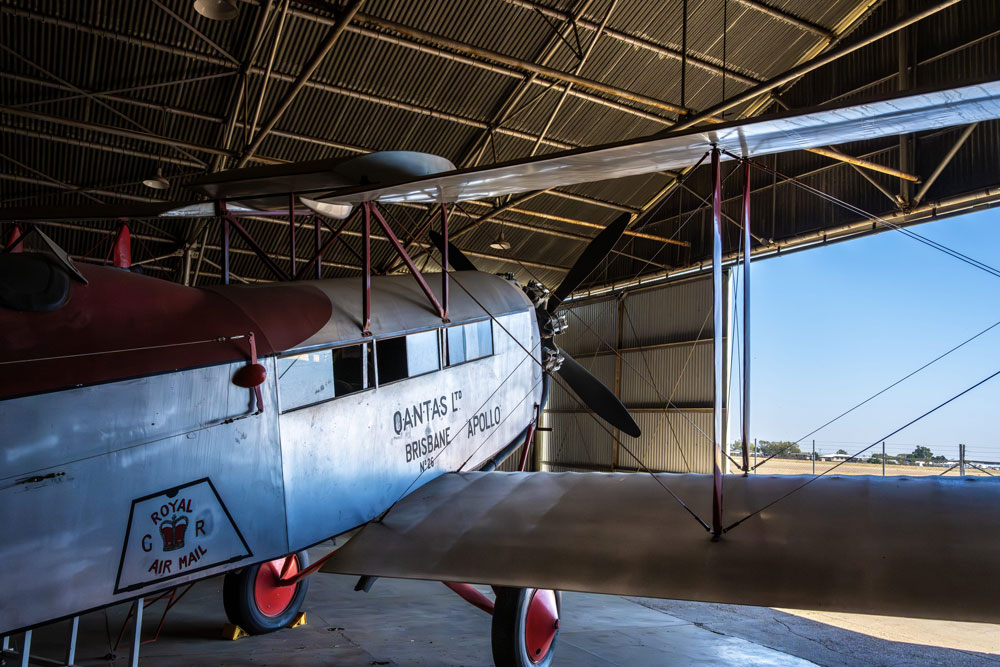
Near the centre of the hangar stands a small biplane. Light, almost fragile in appearance. A replica of the Avro 504K, the first aircraft flown by Qantas. It once carried little more than a pilot and, at most, two passengers. Powered by a modest engine, it feels improbable now. It’s an object from a time when flight was still tentative, its purpose not yet fully defined.
A practical dream
The story begins with distance. Hudson Fysh and Paul McGinness first understood it during the First World War, flying across unforgiving terrain in the Middle East, where aviation revealed itself not as novelty but as utility. A way to bridge what could not otherwise be bridged.
In 1919, while surveying a route for the England-Australia air race, that understanding sharpened. The outback was not empty. It was disconnected.
Back in Queensland, they found support in Fergus McMaster, a grazier who knew isolation as a daily reality. If aircraft could link remote communities, the effect would be immediate, practical and transformative.
So in 1920, in Winton, they formed an airline. Not to impress, but to connect. By 1921, operations had shifted to Longreach. Here, Arthur Baird helped shape what would follow. His work grounded in a simple premise: if something is to fly, it must work. Consistently, reliably and without exception.
Out here, that mattered more than anything else.
The outback equation
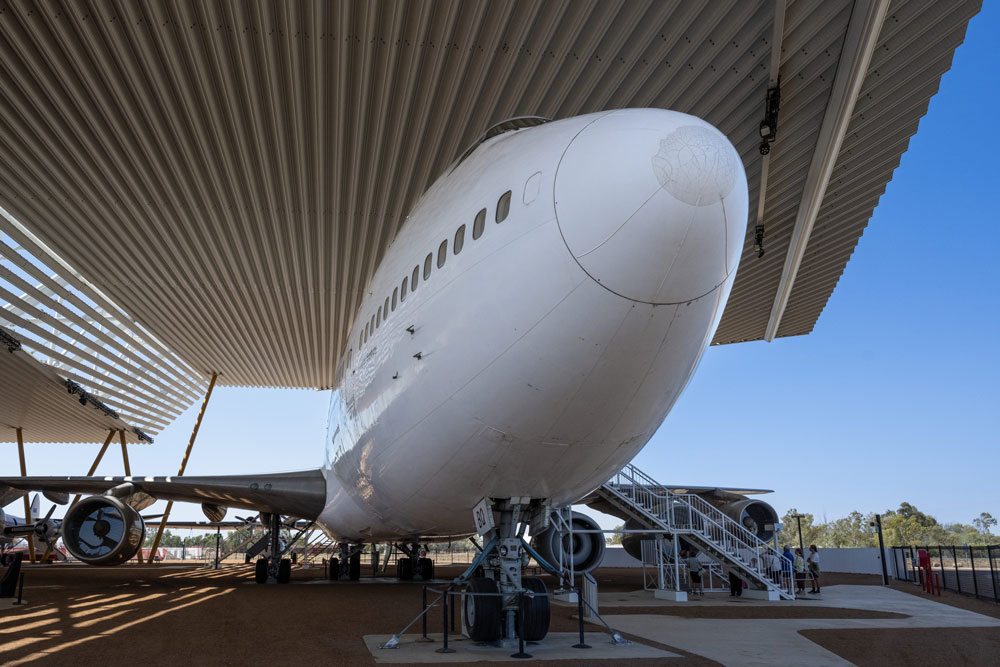
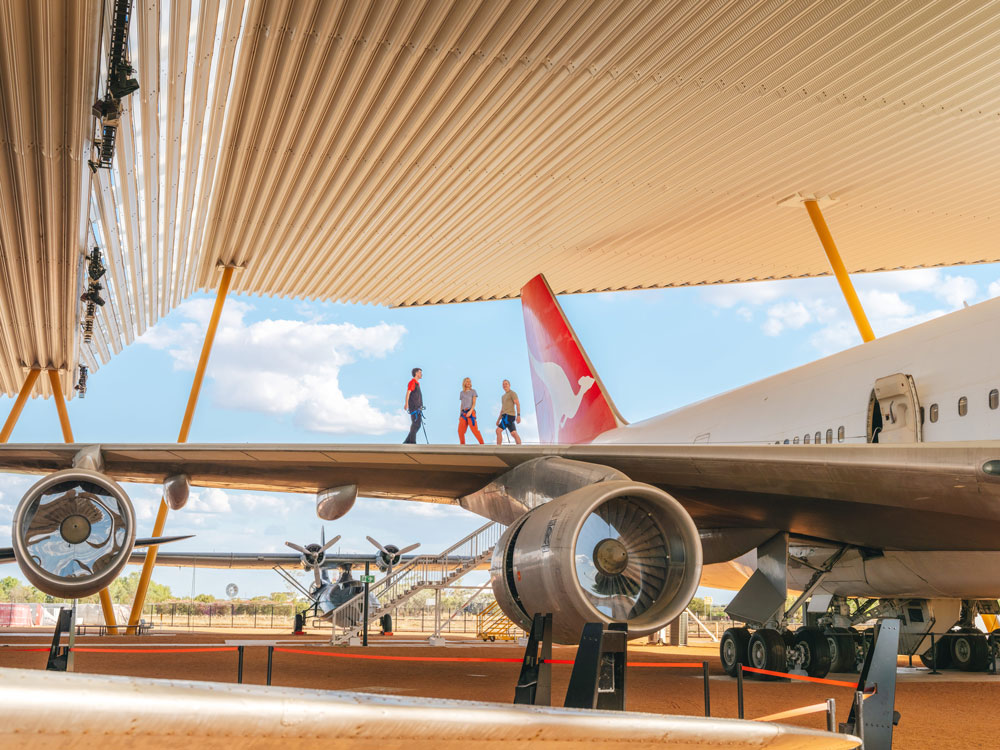
Outside, the light is absolute. Under a vast canopy, aircraft rest in quiet suspension: a Douglas DC-3, a Catalina flying boat, the tapering elegance of a Super Constellation, and beyond them, the broad-backed certainty of a Boeing 747, its metal skin holding the heat and releasing it slowly into the air. Together, they form a timeline you can walk through.
The Douglas DC-3 carries its past visibly. Once a military C-47 during the Second World War, it later entered civilian service. Helping reshape air travel into something dependable and widely accessible. Its wide cargo doors remain. It’s a quiet reminder of its earlier life.
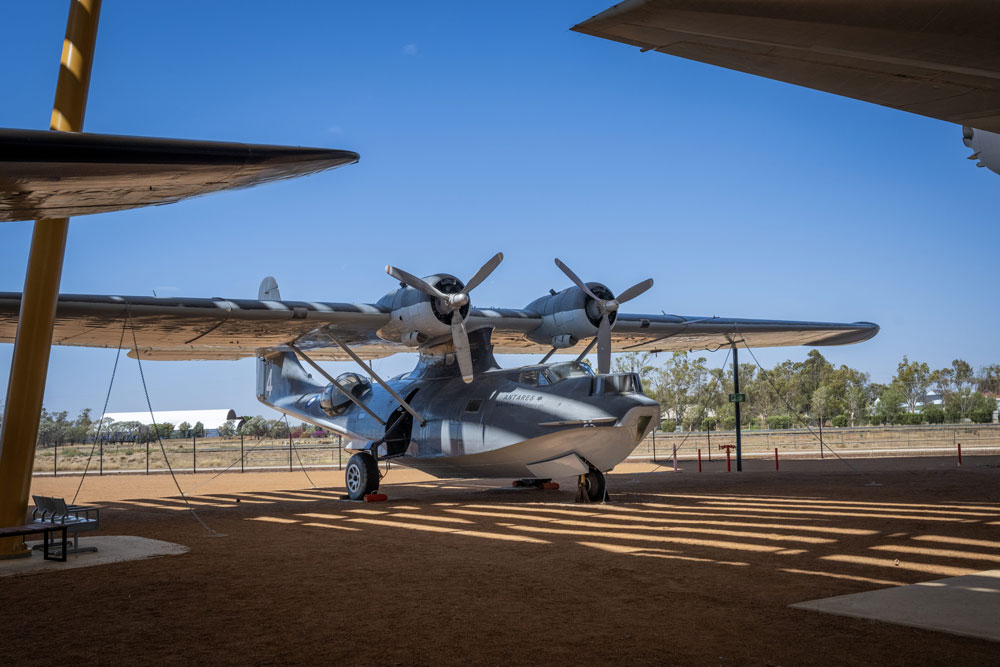
Nearby, the Catalina flying boat tells a different story. Repainted in the colours of the wartime ‘Double Sunrise’ service, it recalls a period when flights from Australia to Ceylon could last close to 28 hours, skirting enemy territory in near silence. At the time, they were among the longest non-stop flights ever attempted. Less a convenience than a necessity.
A man stands beneath the wing of the Super Constellation, his hand resting lightly against the fuselage. He introduces himself without ceremony. He flew for Qantas for three decades. “We trusted the machine,” he says. Then, after a pause: “But more than that, we trusted the people who kept it flying.”
The aircraft behind him marks a turning point. Pressurised cabins. Longer range. The ability to sustain routes like the early Kangaroo Route between Sydney and London. Journeys that could finally be maintained, not just attempted.
We step inside. The cabin narrows. Windows frame a horizon that stretches without interruption. And yet, it worked.
A game crosses oceans
Inside the exhibition hall, the narrative shifts almost imperceptibly. Among sepia-toned photographs and early instruments, a newspaper lies open on a bench, its pages held flat by their own weight. The headline catches just enough light: Qantas as official airline partner of the National Football League. It feels incidental.
Further down the column, the detail sharpens; a 2026 game in Melbourne, where the Los Angeles Rams will meet the San Francisco 49ers. A journey that now barely registers as remarkable. The page lies still.
A sport defined by measured gains, yards at a time, arrives in a country where rugby still shapes instinct. Its rhythm more continuous, less segmented, yet still rooted in territory. Much like the early flights. What once connected cattle stations now connects stadiums.
Then and now
That evening, we return for the light and sound installation.
Projected onto the side of a Boeing 747, images unfold like a fil of lost time. Archival fragments glide by, patterns shift and voices layer over one another. The narrative travels from wartime service through a period of expansion and culminates in the arrival of jet travel. The Boeing 707 marked a decisive shift, halving travel times and introducing Australians to jet lag for the first time. A reminder that speed alters not only distance, but experience.
Then the present enters, almost without friction. Non-stop routes now link Australia and Europe, while ultra-long-haul test flights continue to extend what is possible, with aircraft designed to remain airborne for more than twenty hours. One sequence lingers.
A modern A330-300 lifts into a pale sky, marking the Spirit of the Kangaroo Route, revived in 2026, when the aircraft retraced the historic journey from Sydney to London via Darwin, Singapore, Kolkata, Colombo, Cairo, Toulouse and Rome. In 1947, the same journey took four days, with multiple stops and just twenty-nine passengers aboard. This time, it unfolded across two weeks. Not out of necessity, but by design.
The projection fades. The aircraft returns to stillness.
A human scale
Morning brings a quieter pace. We move slowly through the galleries, where photographs draw us in. Pilots, engineers and early passengers. Until Hudson Fysh appears again. He would lead the airline for decades, guiding it from biplanes to the jet age. Yet here, he is part of something wider; a network of people whose roles overlap and reinforce one another. History resists simplification.
The long reach
We climb into the cockpit of a Boeing 747, once known as City of Bunbury. Over its lifetime, it carried millions of passengers and flew distances equivalent to thousands of journeys around the globe. Now, grounded in Longreach, it serves a different purpose. From here, the view opens completely, the land stretching outward in every direction. Flat, expansive, uninterrupted. Outside, we step onto the wing. The metal still holds the day’s heat. From here, the aircraft feels less like an object than an idea. Refined over time, yet unchanged in essence. Distance remains. Flight answers.
The Light Holds
Late afternoon softens the edges of everything. Aircraft under the canopy catch the light unevenly, their surfaces revealing texture, wear and repair, while beyond them the land stretches outward, pale and unbroken. For a moment, nothing moves. We stand there longer than expected as the heat lifts and the metal slowly cools. Somewhere behind us, a door closes; the sound carries further than it should. Then, almost without noticing, we turn back. The hangar remains.