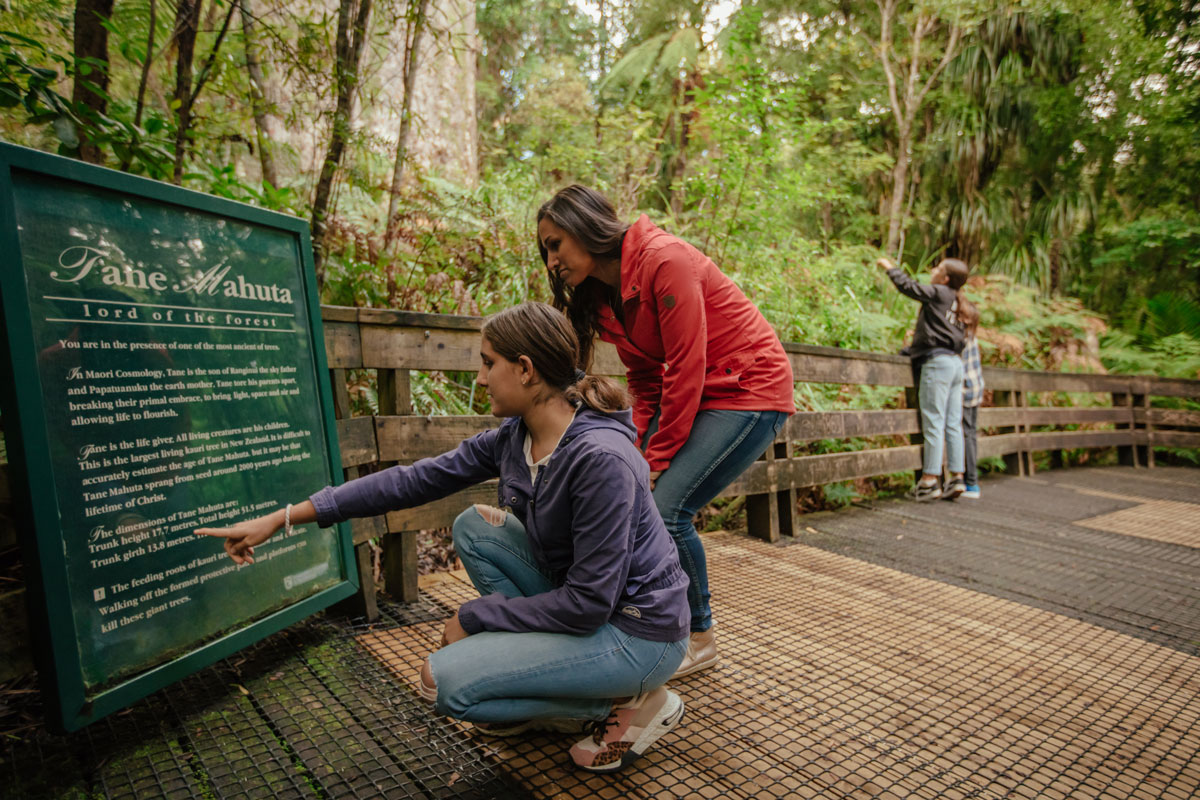
In Northland, New Zealand, a short walk into Waipoua Forest leads us to Tāne Mahuta. It’s a living remnant of an ancient world; where scale, story and survival quietly converge.
We pull over almost without speaking. The road through Waipoua Forest narrows into a corridor of green where light is filtered, held and quietly rationed. When the engine cuts, the silence feels deliberate. Then a tūī calls. Liquid, metallic and the forest answers in echoes that seem to arrive from multiple directions at once. We step out, closing the doors more softly than necessary.
The sign for the Tāne Mahuta Walk is understated. No sense of ceremony. Just a short, level track leading inward. It would be easy to underestimate what lies ahead. Yet the air carries a faint resinous note, and beneath it something cooler. Almost an imperceptible shift, as though the forest moderates its own climate. We begin to walk.
At first, the path feels controlled: timber boardwalk, even footing and a gentle curve between ferns that lean in without touching. Gradually, however, proportions begin to shift. Trunks thicken. The canopy lifts. Light settles into longer, steadier planes. Nothing announces itself. Instead, the forest recalibrates us: quietly and incrementally.
The moment the scale breaks
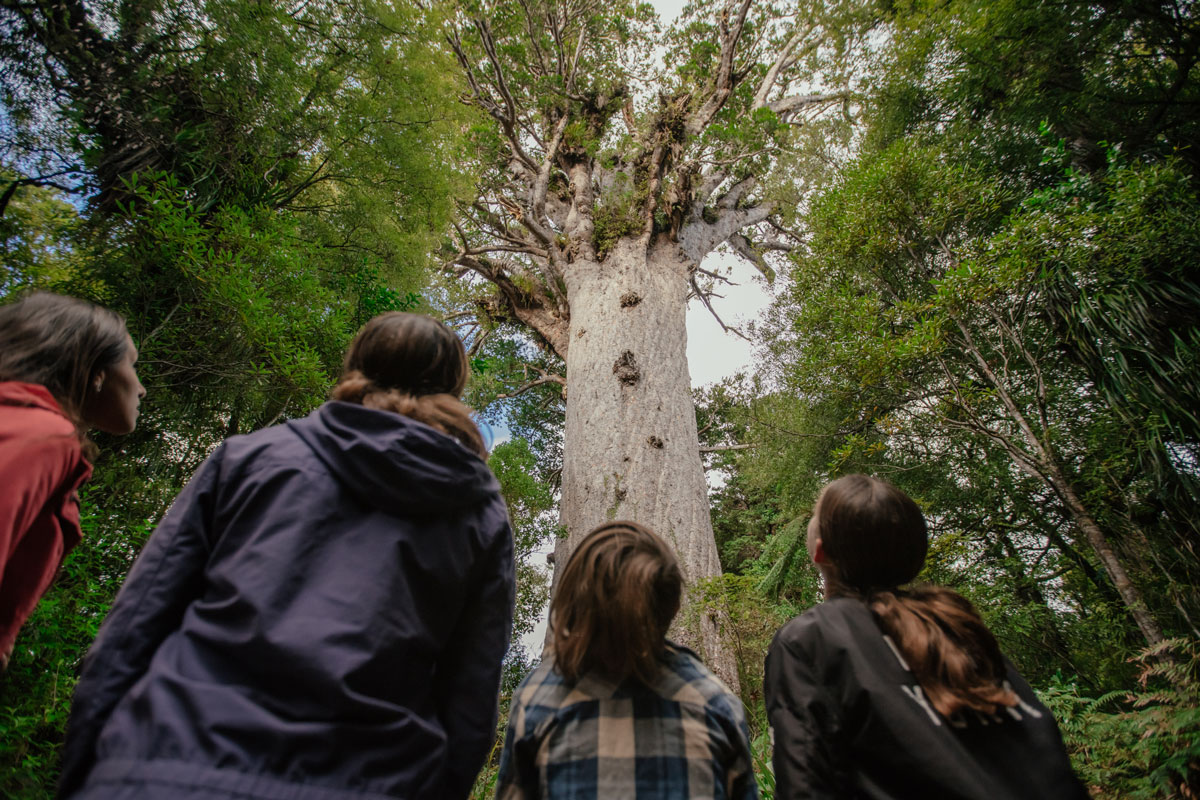
We have come to see Tāne Mahuta, the largest known living kauri and a survivor of the vast subtropical forests that once covered much of Northland. Its age is uncertain; somewhere between 1,250 and 2,500 years. The figures impress, but remain abstract.
Until they don’t. Halfway along the track, we slow without deciding to. The space tightens, then opens just enough. A woman stands ahead, one hand resting on the railing. She glances back. “You’ll feel it before you see it,” she says. Then steps aside.
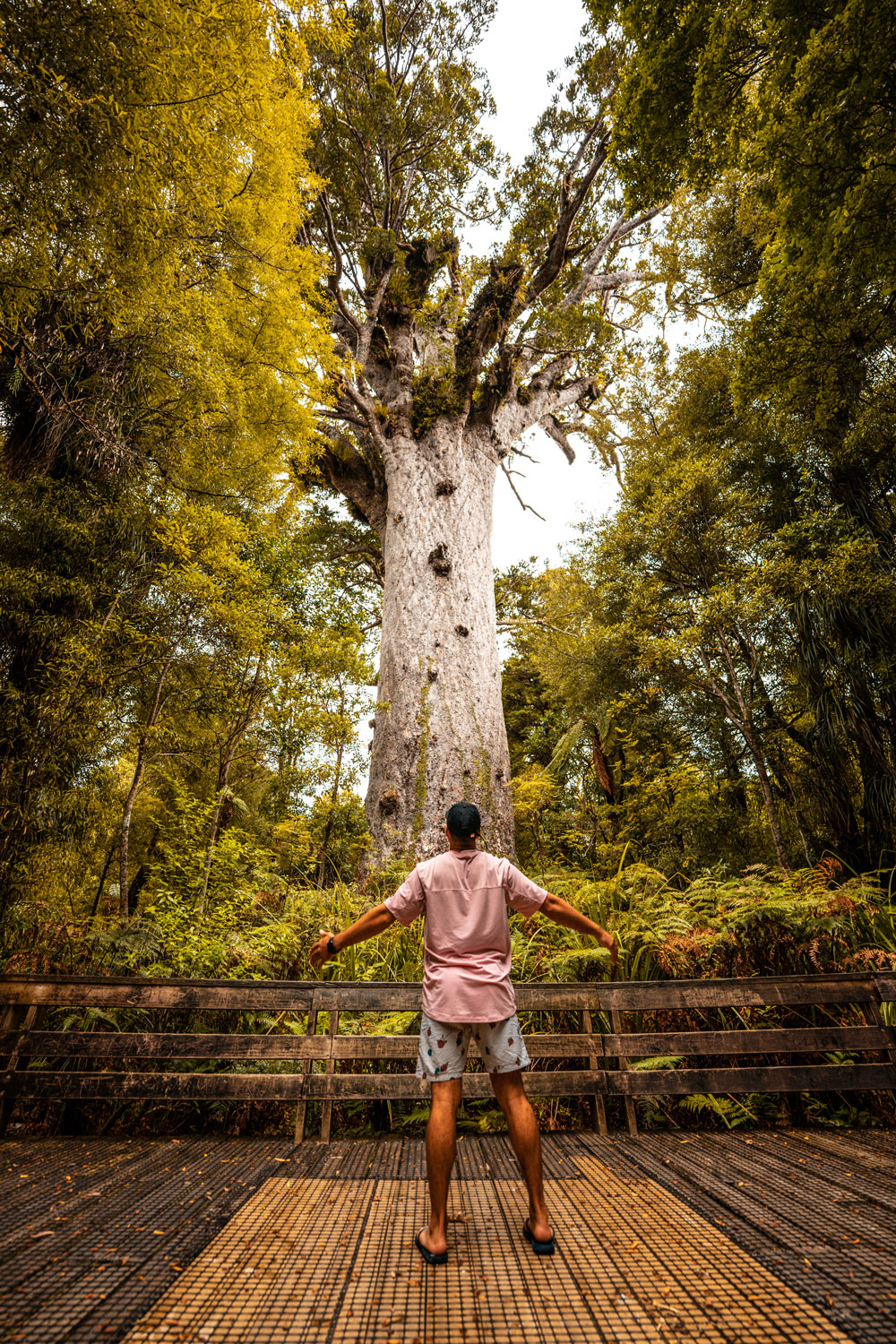
A few steps further, the forest releases its centrepiece. The trunk does not rise so much as assert itself. More than 45 metres tall, over 13 metres in girth, it resists comparison. The bark folds in deep, muscular ridges, pale in places and darkened where moisture gathers. Above, the crown disappears into a layered canopy that refuses a single outline.
We stop at the viewing platform. The instinct is to measure. To translate this into something known. Buildings. Towers. Cathedrals. Yet those comparisons collapse almost immediately. This is not architecture. It is continuity.
Stories that structure the forest
In Māori cosmology, Tāne is the god of forests and birds. The one who separated Ranginui, the sky father, and Papatūānuku, the earth mother, allowing light into the world. All life in the forest descends from him. Standing here, the story does not feel symbolic. It feels descriptive.
A small group gathers behind us. Their guide waits until the group settles.
“Before you take photos,” she says, “just stand.”
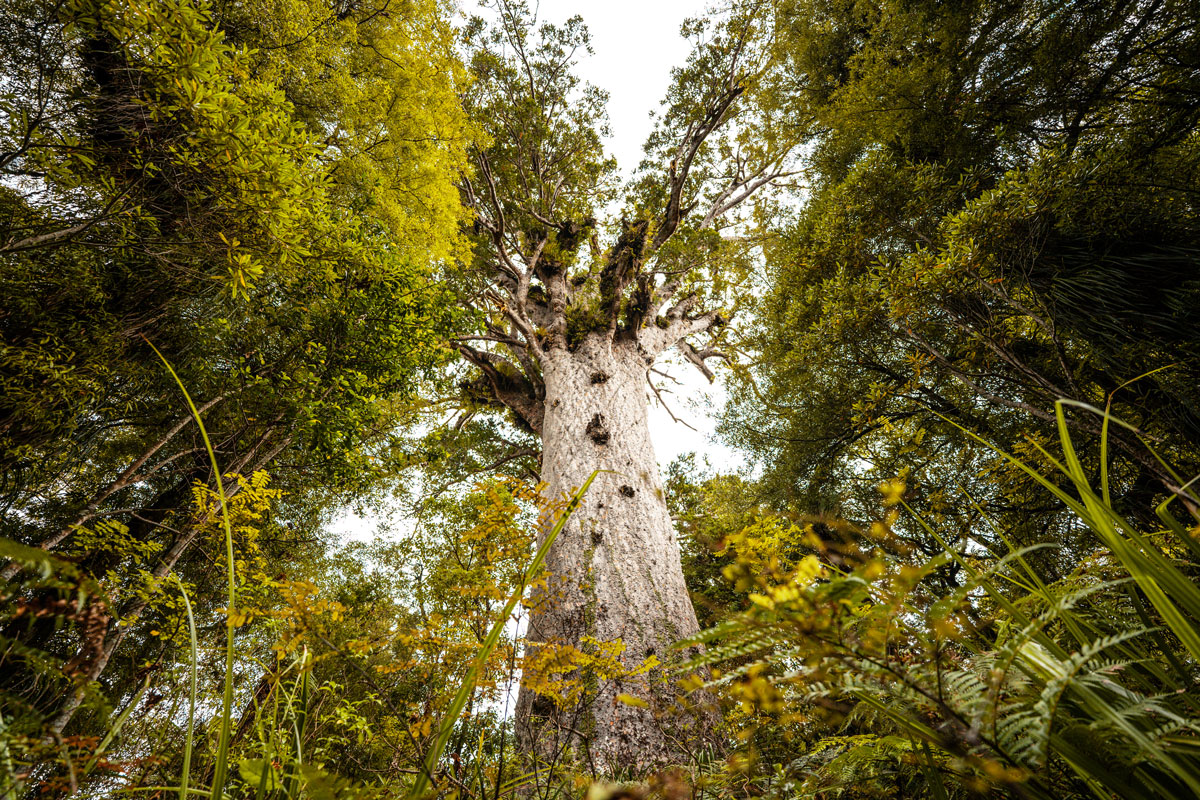
They do. Only then does she continue. She speaks of whakapapa: not only of people, but of place. Of how Tāne Mahuta exists within a network that includes the surrounding forest, the birds above us and even the soil beneath the boardwalk. She gestures deeper into the trees, naming another giant: Te Matua Ngahere. “Different roles,” she says. “Same family.”
A visitor raises a camera, hesitates, then lowers it again. Later, when the group disperses, we linger. The guide, named Marama, remains, her attention on the tree rather than the people.
“How often do you come here?” we ask. “Most weeks,” she says. Then, after a pause: “It’s never quite the same tree twice.”
Fragility beneath the scale
We ask about its health. The question feels oddly personal. “Strong,” she says. “But not separate.”
Kauri dieback, a soil-borne disease, has already affected many trees across Northland. Protection here is precise and visible: cleaning stations, raised walkways and strict instructions to stay on the track. The work is led by the New Zealand Department of Conservation, but it relies just as much on behaviour as on policy. “Most people mean well,” she adds. “That’s not always enough.”
At the start of the track, we remember a family at the cleaning station. The children shifted impatiently while their parents scrubbed their shoes, unsure how thorough was thorough enough.
One of them asked, “Does it really matter?” No one answered. The brush kept moving until the question seemed to fade into the action itself.
“And the fire?” we ask. She nods. In March 2025, flames burned close enough to raise concern. Fire crews worked for days to contain hotspots before they could reach the native forest. The tree was never directly touched. “Close enough,” she says. “You don’t forget that.”
Seeing beyond the singular
We remain after she leaves. From the main platform, the tree feels singular, almost isolated. Further along the track, however, a second viewpoint alters that perception. Here, Tāne Mahuta reads differently. Not as a solitary monument, but as part of a wider system. Surrounding trees, smaller yet substantial, interlock their crowns in a structure that feels cooperative rather than competitive.
A breeze moves through the canopy. The response is layered: a high rustle, then a slower, deeper movement, then stillness. Bird calls arrive without clear direction, displaced within the space. The forest is not quiet. It is organised.
Closer to the ground, detail sharpens. Moisture gathers at the base of the trunk. Fine roots press near the surface, protected by distance and design. A fallen branch nearby is already softening, its edges dissolving back into the soil. Nothing here is static. Not even this.
Leaving the forest behind
Eventually, we turn back. The return walk feels shorter. The car park, when it reappears, brings with it the usual rhythms. Voices, doors and decisions about where to go next. The spell doesn’t break; it simply thins.
Driving south along State Highway 12, the forest gradually gives way to pasture. Fences impose lines. Houses sit back from the road, their scale suddenly legible again. The transition is subtle but definitive.
What remains behind is not just a tree, but a fragment of continuity. Tāne Mahuta endures within a landscape that has been reduced, protected and negotiated. Its survival is not incidental. It is the result of choices, ongoing and necessary.
We pull over once more, this time without a marker. The forest edge rises in a dark, uneven line. From here, nothing distinguishes what lies within. No hint of scale. No suggestion of what stands beyond sight.
A breeze lifts from the trees and crosses the road, carrying that same resinous trace. It dissipates quickly in the open air, losing coherence as it moves.
Behind it, the forest holds its own. We drive on. In the rear-view mirror, the green narrows, then disappears entirely as the road bends away. Yet something lingers. Not awe, exactly, but adjustment. A quieter recalibration of scale and time.
Somewhere beyond the reach of the road, beyond the ease of access, Tāne Mahuta continues rooted in relationships that extend far beyond its own form. Not monumental in the way we usually define it. But enduring.