Merlín, mariachi and a World Cup night in the Zócalo
The World Cup may have brought us to Mexico City, but by the end of the evening football feels almost incidental. At eight o’clock on a warm June evening, we step into Casa Barista, a small café tucked among the historic streets of the Centro Histórico. Barely two hours earlier, after almost twelve hours in the air, we landed in Mexico. The journey still clings to us. Our watches insist it is one time, our bodies another. Outside, one of the world’s largest cities is preparing for a World Cup match between Mexico and South Korea. Inside, however, the evening seems determined to move at its own pace.
The café glows beneath strings of warm lights. A mural stretches across one wall in swirling shades of blue and white, somewhere between Van Gogh and magical realism. People linger over iced coffees, a young couple share a pastry decorated in the colours of the Mexican flag, and nobody appears in any particular hurry. The city may be counting down to kick-off, but here the anticipation feels unforced, almost leisurely. Then our cappuccino arrives. Floating in the milk foam is a remarkably detailed cat, complete with whiskers, pointed ears and an expression that suggests it has already formed an opinion about us.

The barista catches us staring. “Too cute to drink?” We nod. She laughs. “Everybody says that.” The cat feels oddly appropriate. South Korea are Mexico’s opponents tonight, and something about the feline face in the foam seems faintly Korean. Around us, green shirts dominate the room. Phones glow with team news, snippets of football conversation drift between tables and a radio presenter somewhere in the background debates the evening’s line-up. Yet the atmosphere feels less like the build-up to a sporting event than the opening act of a celebration.
A city walking towards a same destination
When we step back onto the street, dusk has settled across the city and the crowd is moving in a single direction. We join the flow, allowing ourselves to be carried through the historic centre towards the Zócalo. Music spills from open doorways. Vendors appear on street corners carrying scarves, whistles and flags. Every television screen seems tuned to the same channel. Nobody needs signs; the crowd itself provides navigation.
As we walk, the city reveals itself in layers. Colonial facades rise above foundations that once belonged to Tenochtitlan, the great Aztec capital upon which modern Mexico City was built. Church towers emerge between office blocks. Streetlights flicker into life. The smell of grilled meat drifts from market stalls while roasted corn crackles over portable braziers. Somewhere ahead, a mariachi trumpet rises above the traffic, briefly transforming the surrounding streets into the soundtrack of the evening. Football may be the reason everyone is heading in the same direction, but the city never allows itself to become merely a backdrop.
The streets suddenly widen and, almost without warning, the Zócalo opens before us. Even after seeing photographs, the scale is difficult to comprehend.
The square feels less like a public space than a landscape: an immense expanse of stone framed by some of the most important buildings in the country and anchored by a giant Mexican flag that dominates the skyline. Tens of thousands of people are already gathering beneath it. Families spread blankets across the paving stones. Office workers arrive directly from work. Children weave between groups of supporters. Everywhere, people are talking, laughing, eating and taking photographs.
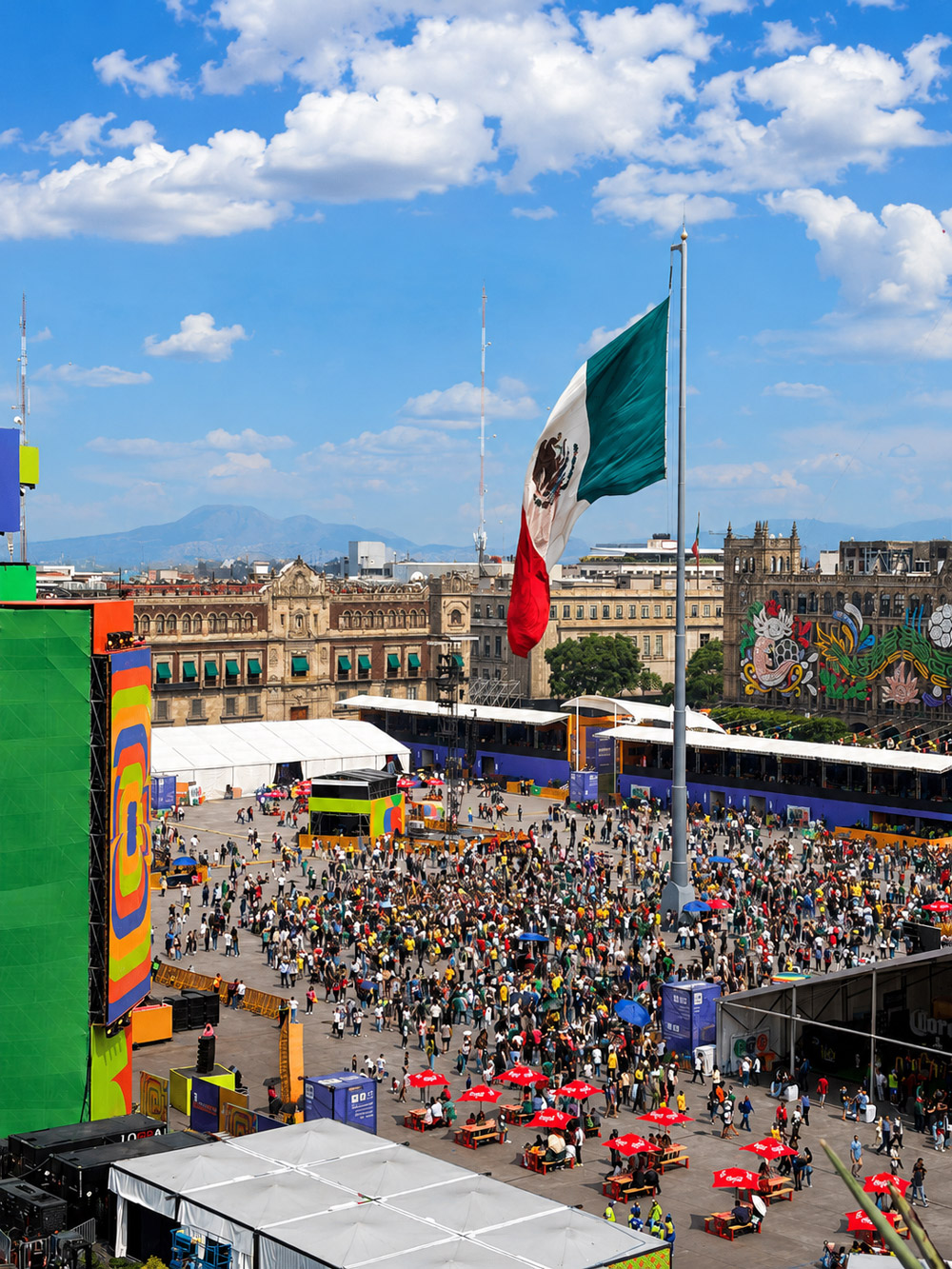
The smell of beer, grilled beef and roasted corn hangs in the warm evening air. Vendors weave through the crowd carrying trays of drinks while a mariachi band near the edge of the Fan Fest launches into another song. The result feels less like a football viewing party than a national gathering. The Zócalo has always served as the symbolic heart of Mexico. Built atop the ceremonial centre of the Aztec empire and later reshaped by Spanish colonisers, it has witnessed revolutions, celebrations, protests and moments of national mourning. Tonight, football joins that long history.
Near one of the entrances we meet Roberto, a retired schoolteacher carrying a folding chair beneath one arm. He looks as though he has been coming here all his life, which, as it turns out, he has. “You’ve come for the match?” he asks. We tell him we have. He smiles. “You’ve come for the Zócalo.” Roberto was born in Mexico City. His father brought him here as a child and now he brings his grandchildren. Looking across the crowd, he gestures towards the vast plaza and the giant flag moving gently above it. “If something matters to Mexico,” he says, “sooner or later it comes here.” The statement requires no elaboration. The crowd itself proves his point
Families sit beside students, office workers stand shoulder to shoulder with street vendors, and elderly couples settle into folding chairs while children dart through the gathering carrying miniature flags. Many supporters wear the green shirt of the national team. Others have chosen a more theatrical expression of patriotism. Colourful lucha libre masks appear everywhere, some shimmering in silver and gold, others decorated with the colours of the Mexican flag. One supporter has attached feathers to his mask. Another appears to have transformed himself into a walking tribute to both football and professional wrestling. Together they lend the evening the atmosphere of a carnival.
The ducks that stole the World Cup
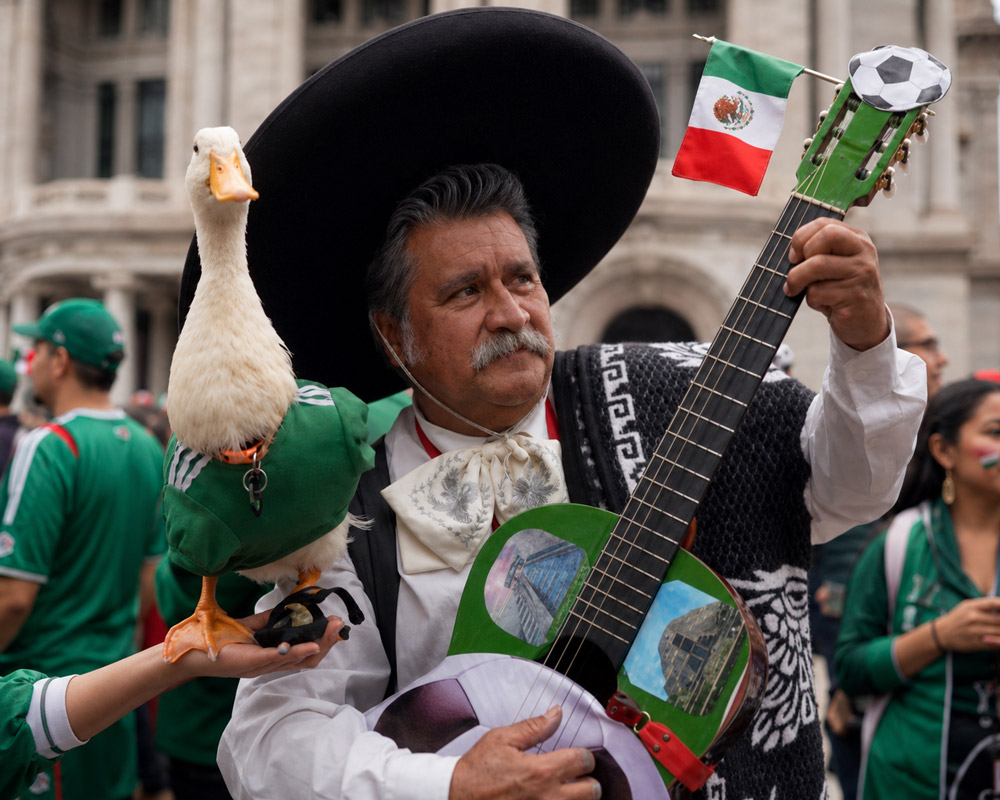
A ripple suddenly moves through the crowd near the edge of the Fan Fest. Phones rise above heads. People begin smiling and pointing. For a moment we assume a footballer has appeared. Instead, the centre of attention turns out to be a duck. His name is Merlín. Long before the World Cup arrived, he was already a familiar sight in the historic centre, waddling through the streets alongside his owners, Karla Gómez and Cristian, who sell bottled water nearby. The tournament, however, transformed him into something approaching national celebrity. Television crews follow him. Social media adores him. Bakers produce Merliconchas in his likeness. According to supporters around us, FIFA has even named him an ambassador for the Fan Fest. Whether every detail is entirely accurate seems beside the point. What matters is that people love him. A young woman standing nearby notices our confusion. “You don’t know Merlín?” Apparently we do not. She laughs. “Then welcome to Mexico.”
More than a football match
As kick-off approaches, the giant screens glow brighter against the darkening sky and conversations gradually soften. The national anthem begins and tens of thousands of voices rise together. The sound rolls across the square, echoes from the surrounding buildings and rises towards the enormous flag overhead. For a brief moment, football itself seems secondary. Standing in the centre of the Zócalo, surrounded by strangers singing the same anthem beneath the same flag, it becomes clear that this evening is about far more than ninety minutes of sport.
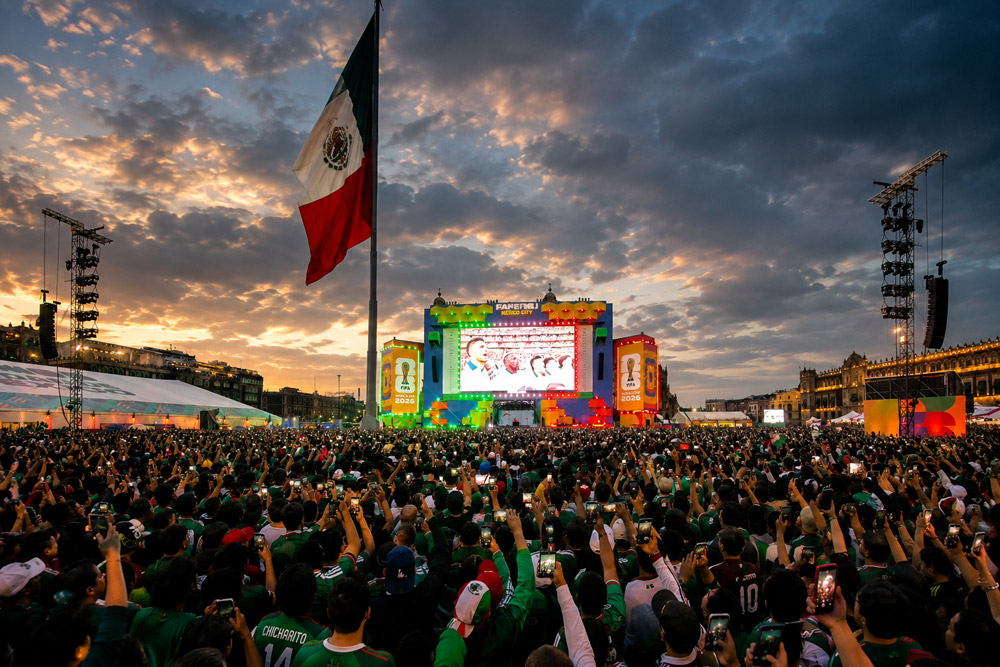
When the match begins, we quickly discover that the crowd is every bit as fascinating as the game. Near one of the food stalls we meet Carlos, who has spent fifteen years selling drinks in the historic centre. He barely glances at the giant screen. “Have you watched much of the match?” we ask. “Only the important parts.” “What are the important parts?” “The goals.” He grins. “When everybody screams, I look up.”
Watching the crowd soon becomes its own form of entertainment. Anticipation moves through the square in waves. A promising attack lifts thousands of heads. A missed chance triggers a collective groan. Songs emerge spontaneously before dissolving into laughter and conversation. Plastic cups of beer pass from hand to hand. The smell of grilled meat and roasted corn drifts across the plaza. Every so often, the mariachi musicians reappear somewhere in the distance, their trumpets briefly rising above the crowd before being swallowed once more by the noise of the Fan Fest.
When Mexico finally score, the reaction sweeps across the Zócalo like a gust of wind. Plastic cups are launched skywards, flags suddenly emerge above the crowd and strangers throw their arms around one another as though they have known each other for years. The roar ricochets off the colonial facades surrounding the square before rolling away into the night. For several seconds, the Zócalo seems to possess a single heartbeat.
Not long afterwards, a light rain drifts across the plaza. The first drops catch the glow of the giant screens before landing on the paving stones, where they gradually transform the square into a mosaic of reflections. Supporters glance upwards, smile and carry on. Some pull on lightweight jackets. Others simply continue singing. Within minutes, the Zócalo gleams beneath reflected light while the giant flag continues to move gently overhead. Nobody leaves. If anything, the rain seems to draw people closer together.
As the second half unfolds, another duck appears. This one is dressed in green. The reaction is immediate. “Juanita!” Phones emerge once more and supporters point excitedly. Somewhere along the way, social media has decided that Juanita and Merlín are romantically involved. Nobody appears entirely certain where the story originated and nobody seems especially concerned about verifying it. Within minutes, complete strangers are discussing the relationship status of two ducks with the seriousness usually reserved for tactical analysis. Football tournaments create heroes. Mexico, apparently, creates celebrity waterfowl.
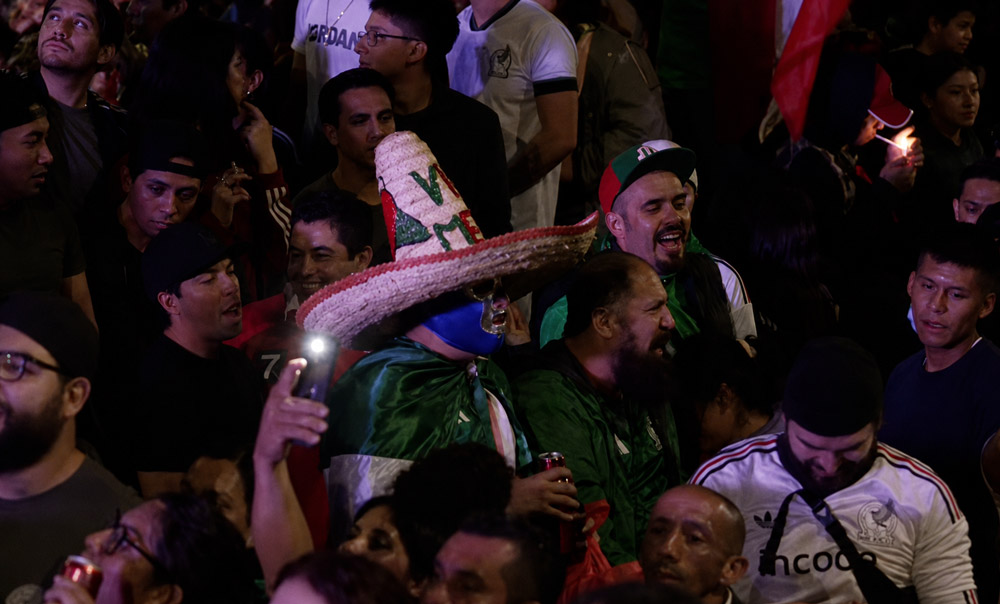
As darkness settles fully over the city, the colonial buildings surrounding the square glow beneath artificial light and rainwater shimmers across the paving stones. Increasingly, we find ourselves watching faces rather than football. Near us stands Fernanda, a twenty-three-year-old architecture student with a Mexican flag painted on her cheek. “You could watch this at home,” we say. She looks around at the sea of people stretching across the plaza. “No,” she replies. “We could watch the match at home.” Then she gestures towards the crowd. “But you can’t watch Mexico at home.” It is the most insightful observation of the evening. Because she is right. This gathering is not really about football. It is about occupying a shared space and sharing a moment. It is about thousands of people choosing to spend an evening together beneath the largest flag in the country. The match provides the reason. The city provides everything else.
When the final whistle confirms Mexico’s 1–0 victory over South Korea, celebrations erupt once more. Music appears almost instantly. People dance. Families pose for photographs. The mariachi band returns. Nobody seems particularly eager to leave. Why would they? The Zócalo itself is the attraction. Football merely provided the occasion.
The morning after
The following day, the square feels both familiar and entirely different. When we return shortly after midday, the giant flag is still moving above the plaza, but the atmosphere has changed. The floodlights are gone, the giant screens stand silent and the echoes of the previous evening have dissolved into the rhythm of an ordinary day. Street sweepers move across the paving stones where thousands celebrated only hours earlier. Families stroll through the square. Office workers cut diagonally across the plaza on their lunch break. The World Cup remains visible everywhere, yet the city has resumed being itself.
That is perhaps the most remarkable thing about Mexico City. Even an event as large as the World Cup never entirely overwhelms it. The tournament becomes another layer rather than the whole story. Around the edges of the Fan Fest, national pavilions are already attracting visitors. We wander between them, moving from country to country without ever leaving the Zócalo. At the Dutch pavilion, marked simply as Países Bajos, a small queue has formed. Inside, visitors browse displays of Dutch products while curious Mexicans sample foods that have travelled considerably further than we have. The sight of stroopwafels in the centre of Mexico City feels faintly surreal. One supporter studies them with the concentration usually reserved for tactical diagrams. “What are they?” he asks. We explain. He buys a packet immediately.
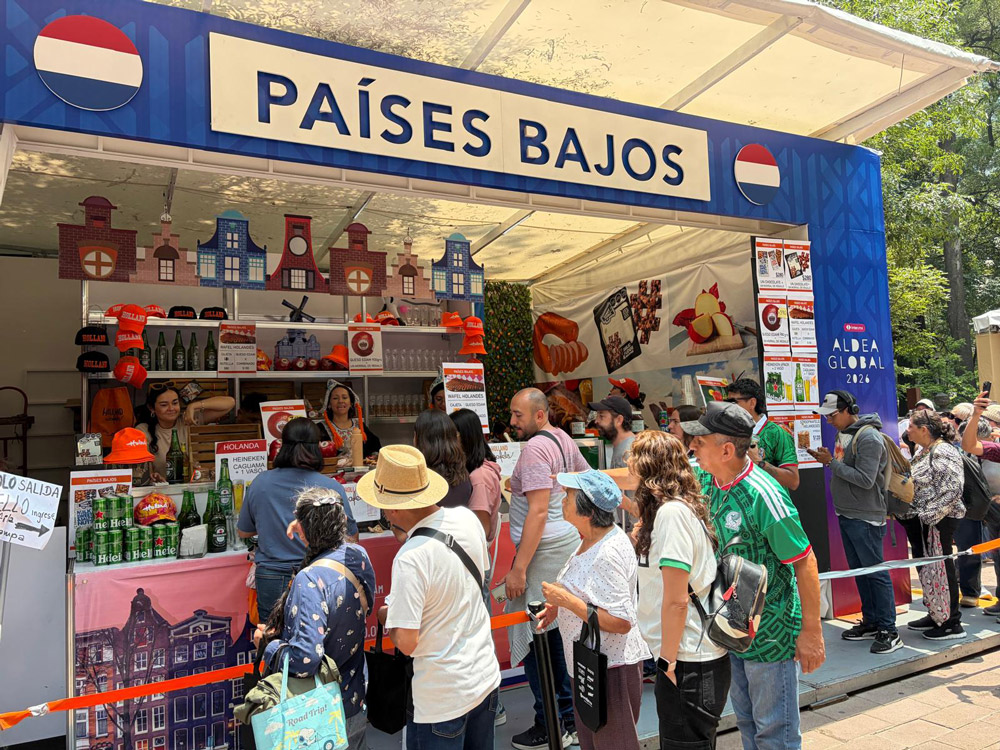
The World Cup is often described as a celebration of football, but moments like this suggest it is equally a celebration of curiosity. Thousands arrive for a match and leave having discovered something entirely unrelated to the game. As the afternoon unfolds, we find ourselves drifting back through the historic centre towards Casa Barista. The same mural still stretches across the wall. The same warm lights hang from the ceiling. The same sense of calm remains untouched by the scale of the event unfolding outside. We order coffee and, almost inevitably, a stroopwafel acquired from the Dutch pavilion. The pairing turns out to be perfect. Outside, Mexico City continues its World Cup. Supporters are already discussing the next match. Vendors are setting up for another evening. Somewhere in the historic centre, Merlín is almost certainly attracting another crowd.
We sit for a while longer, watching the city move past the window. The previous night had been filled with giant flags, mariachi music, celebrity ducks, rain showers, wrestling masks and the roar of tens of thousands of people celebrating a 1–0 victory.
Yet as the coffee cools and the afternoon light settles over the streets outside, it becomes clear that the memory we will take home is larger than any result. Mexico may have beaten South Korea. What we discovered in the Zócalo was Mexico itself.